Quick answer
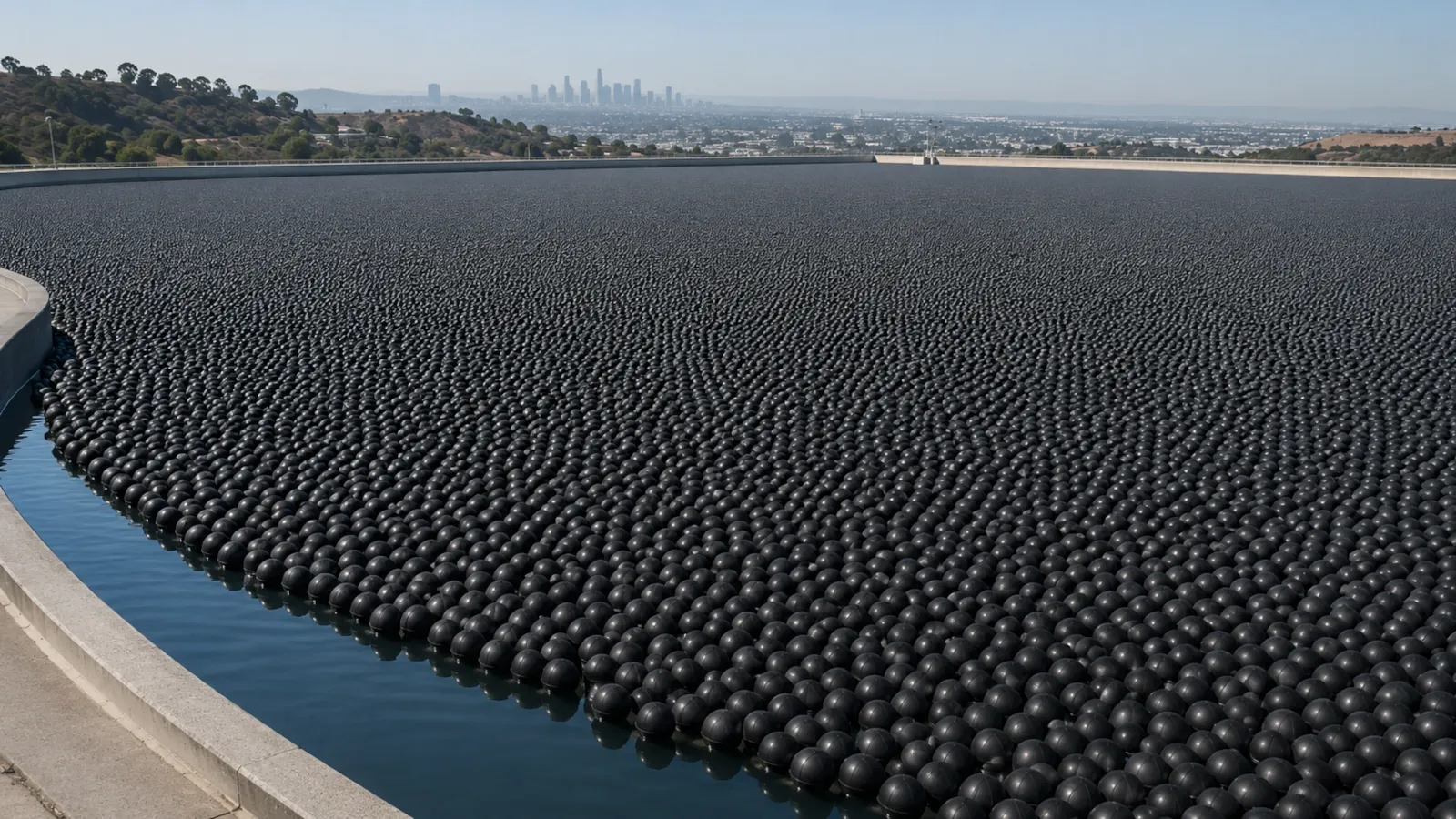
The more than 96 million black balls covering the Los Angeles Reservoir are shade balls: four-inch floating spheres made from high-density polyethylene (HDPE). Their primary job is not simply to stop evaporation. Los Angeles uses them mainly to protect drinking-water quality by blocking sunlight that can trigger unwanted chemical reactions and encourage algae growth.
At the Los Angeles Reservoir, the balls also reduce evaporation, lower the amount of chlorine needed for algae control, and help the water system comply with federal drinking-water rules. LADWP says the reservoir covers about 175 acres, holds more than 3.3 billion gallons of water, and remains covered by more than 96 million shade balls installed as part of the 2015 project.
The most important point is this:
Myth: Los Angeles dumped 96 million black balls into a reservoir mainly to save water from evaporation.
Reality: The primary purpose was water-quality protection. Evaporation reduction is a substantial additional benefit.
When to use this solution
This guide is for anyone who has seen photographs or videos of a Los Angeles reservoir covered in black spheres and wants to understand what they actually are, why they were installed, whether they are safe, and whether they work.
It is also useful if you are researching:
- what shade balls are used for;
- why shade balls are black;
- why Los Angeles needed about 96 million of them;
- whether shade balls reduce evaporation;
- whether plastic can safely touch drinking water;
- how much the Los Angeles project cost;
- the environmental trade-offs of using millions of plastic spheres;
- whether the shade balls are still in the Los Angeles Reservoir.
This is an explanation of a municipal water-treatment and reservoir-management system, not a recommendation to place ordinary plastic balls in a private pool, tank, pond, or drinking-water supply.
Before you start
A few distinctions make the entire story easier to understand:
- Los Angeles Reservoir is drinking-water infrastructure, not a recreational lake.
- Bromide and bromate are different substances. Bromide can occur in source water; bromate is a regulated contaminant that can form under certain treatment and environmental conditions.
- Shade balls are one part of a larger treatment system. They do not replace filtration, disinfection, monitoring, or the ultraviolet treatment facility used at the reservoir.
- The widely quoted “96 million” figure is a deployment figure. Recent LADWP material describes the reservoir as covered by more than 96 million shade balls.
- Evaporation matters, but it was not the original primary reason for the project.
What are shade balls?
Shade balls are floating plastic spheres designed to cover large portions of an open water surface.
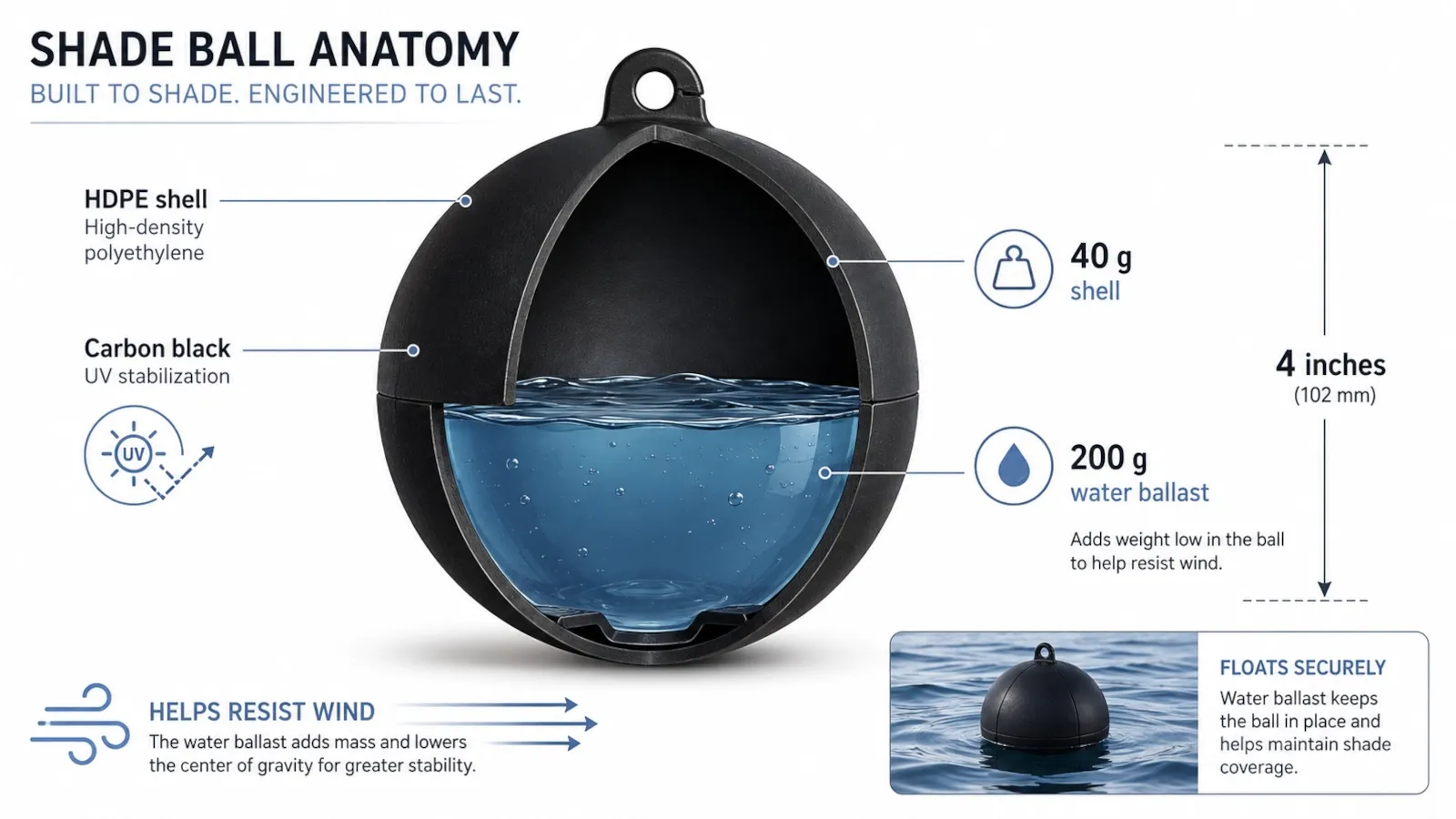
The shade balls used at the Los Angeles Reservoir are approximately 4 inches (10 cm) in diameter and are made from high-density polyethylene, or HDPE. LADWP says each ball used there weighs about 40 grams before ballast and contains roughly 200 grams of drinking water to help keep it in place during strong winds.
They work collectively rather than individually. One ball does almost nothing. Tens of millions packed together create a floating layer that greatly reduces the amount of sunlight reaching the water.
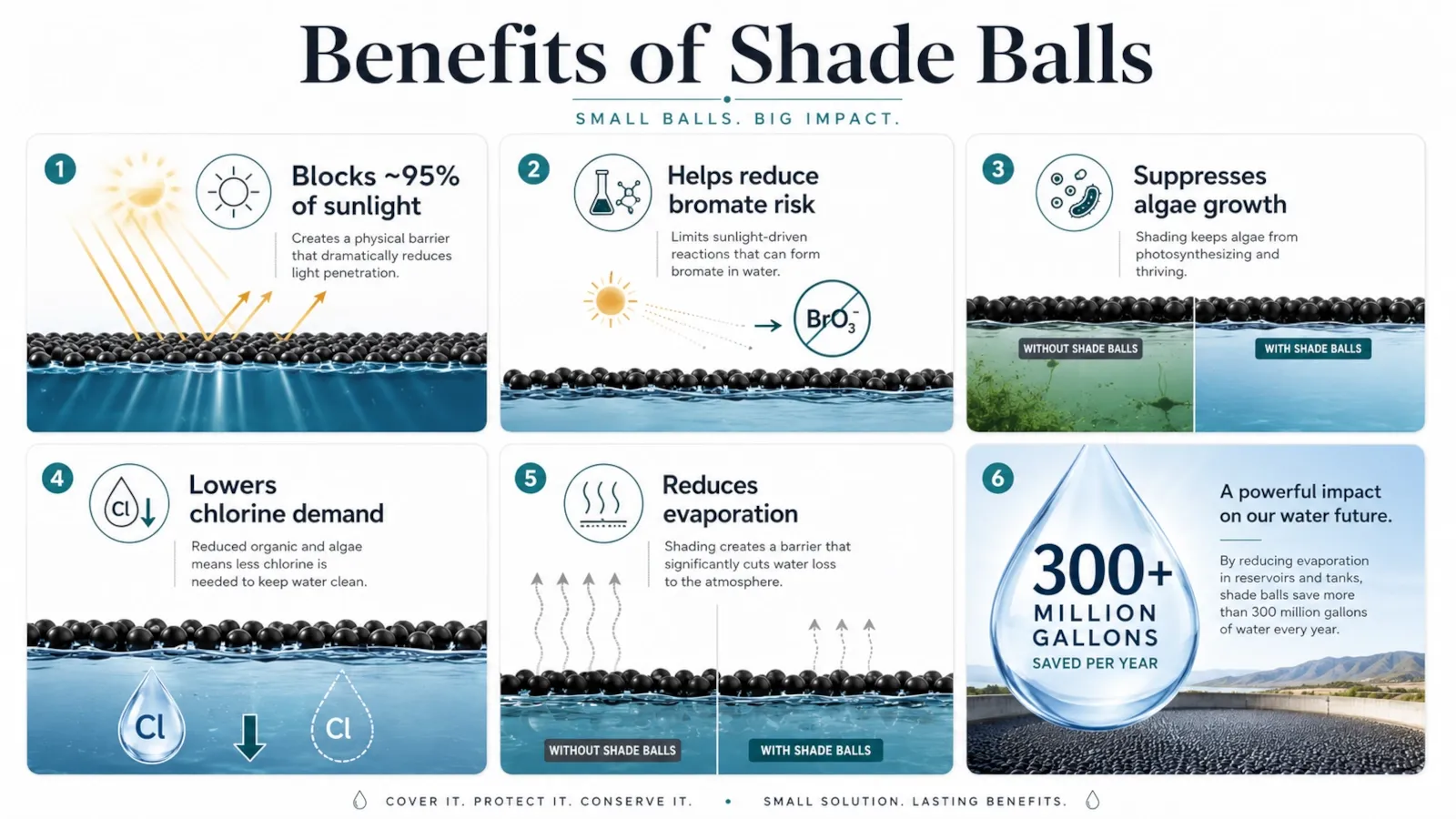
That simple physical effect — shading the surface — has several consequences:
- it suppresses sunlight-driven chemical reactions;
- it limits algae growth;
- it reduces the chlorine needed for algae control;
- it reduces the exposed water surface and air movement immediately above it, lowering evaporation.
The visual effect is unusual, but the engineering principle is straightforward: if sunlight is creating or worsening a water-quality problem, cover the surface with a material that can float, survive outdoors, and safely contact drinking water.
Why did Los Angeles put 96 million shade balls in the reservoir?
The project was fundamentally about protecting water quality and meeting drinking-water requirements.
Before shade balls were used widely, LADWP investigated unexpectedly elevated bromate levels in several uncovered reservoirs. Bromate is a regulated drinking-water contaminant. It is commonly associated with ozonation, because ozone can react with naturally occurring bromide in source water.
Los Angeles encountered a less expected pathway.
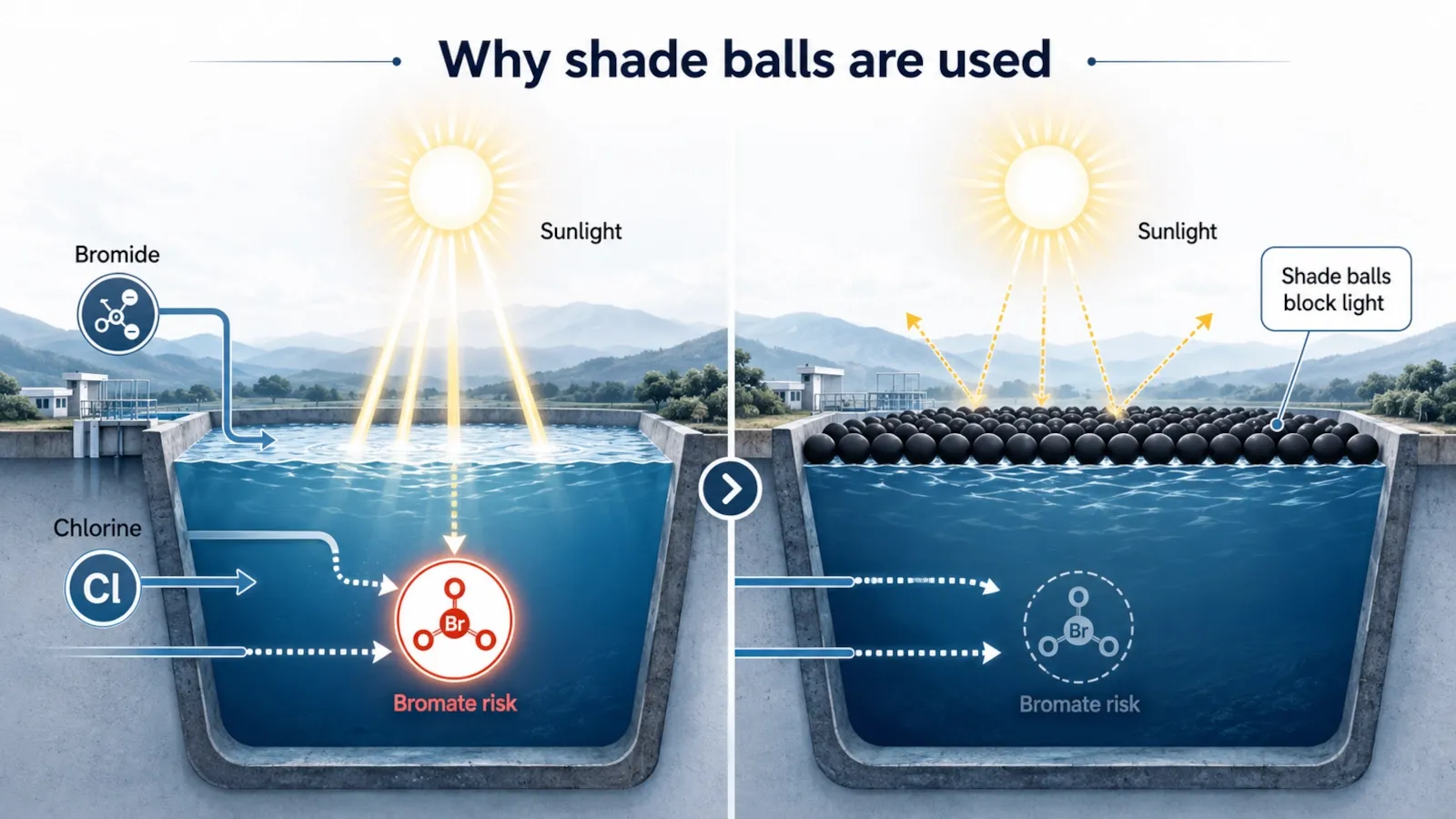
LADWP’s investigation found that water containing bromide and chlorine could form bromate when exposed to strong sunlight. In reservoir experiments, samples closer to the surface — where sunlight exposure was greater — produced more bromate. The utility reported that bromate formation dropped dramatically when light transmission was reduced.
That changed the engineering problem from:
“How do we redesign the chemistry of the entire reservoir?”
to something much simpler:
“How do we stop enough sunlight from reaching the water?”
Shade balls became a fast, comparatively low-cost way to do that.
The bromide-to-bromate problem, explained simply
The chemistry is more complicated than a single schoolbook equation, but the practical chain can be understood like this:
Bromide in source water + chlorine + strong sunlight → conditions that can promote bromate formation
Bromide itself is not the same thing as bromate. The concern is the conversion process.
The U.S. Environmental Protection Agency regulates bromate in drinking water. The federal maximum contaminant level is 0.010 mg/L (10 parts per billion). EPA’s health information notes that long-term exposure above the standard may increase cancer risk.
LADWP’s tests indicated that reducing sunlight was an effective way to interrupt the reservoir-specific pathway it had observed. According to the utility, the shade-ball layer blocks about 95% of sunlight, helping prevent bromate formation.
This is why describing the project only as an “anti-evaporation trick” misses the central engineering problem.
How shade balls work, step by step
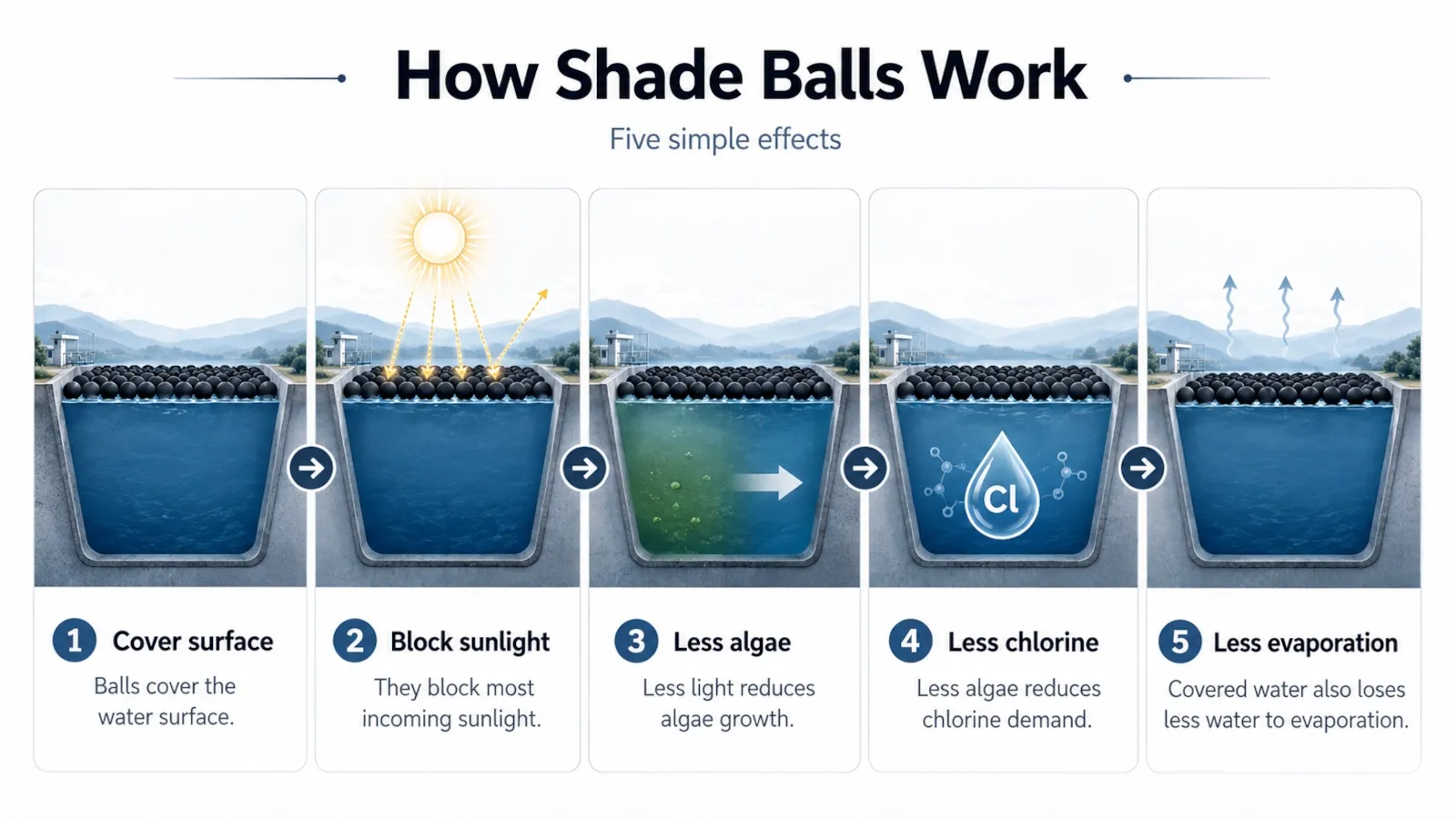
1. The balls cover the exposed surface
Millions of spheres spread across the reservoir until they form a dense floating layer.
Because the balls move with the water surface, the cover can adapt as the water level changes without requiring a rigid roof over the entire reservoir.
2. The layer blocks most incoming sunlight
LADWP says the shade balls block roughly 95% of sunlight. That is critical because the utility’s investigation linked strong sunlight exposure to bromate formation in chlorinated water containing bromide.
3. Less light means less algae growth
Algae need light. Reducing light penetration suppresses algal blooms in an uncovered reservoir.
That matters because controlling algae otherwise requires additional treatment.
4. Less algae means less chlorine is needed for algae control
By reducing algae growth, the reservoir can require less chlorine for that specific purpose.
This creates a second water-quality benefit: when organic material from algae reacts with chlorine, additional disinfection byproducts can form. Reducing algae and chlorine demand helps reduce those conditions.
5. The floating layer also reduces evaporation
With most of the surface covered, less water is directly exposed to sunlight and wind.
LADWP estimates that a fully covered reservoir can avoid up to about 90% of the evaporation that would otherwise occur under those conditions, and says the Los Angeles Reservoir saves more than 300 million gallons of water per year.
That is a major benefit — just not the original primary reason the shade balls were chosen.
Why are there about 96 million shade balls?
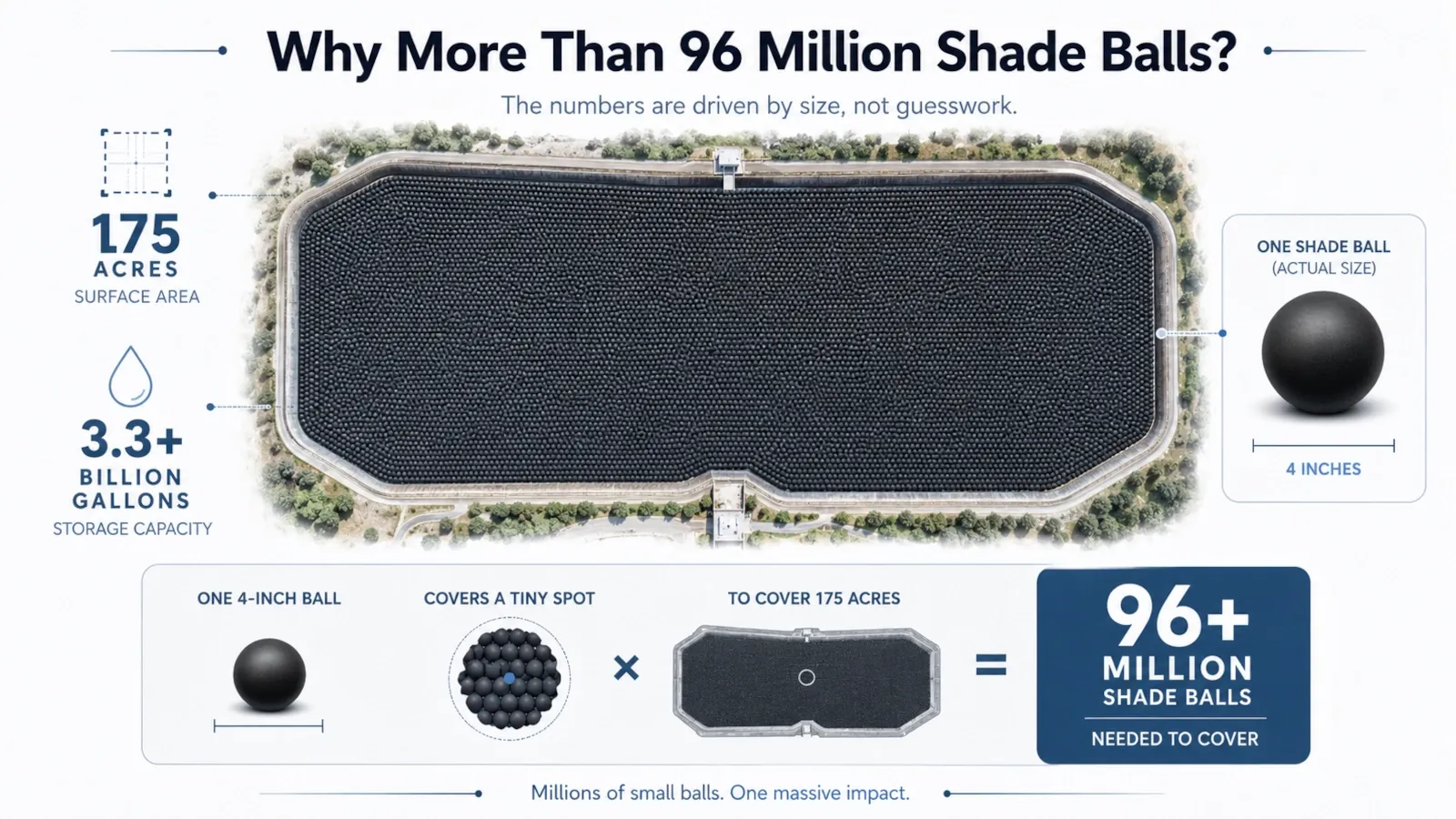
Because the Los Angeles Reservoir is enormous.
LADWP’s 2025 public material describes it as the department’s largest active in-basin reservoir, with:
| Reservoir fact | LADWP figure |
|---|---|
| Surface area | about 175 acres |
| Storage | more than 3.3 billion gallons |
| Shade-ball diameter | 4 inches |
| Shade balls | more than 96 million |
| Major deployment | 2015 |
A single layer must cover most of that 175-acre surface closely enough to block the required amount of light.
The famous “96 million” number should therefore be understood as an engineering scale problem: small spheres multiplied by the surface area of a very large reservoir.
It is also worth avoiding false precision. Older LADWP materials sometimes use slightly different rounded counts. The safest current description is the one used in recent LADWP material: more than 96 million shade balls cover the Los Angeles Reservoir.
Why are shade balls black?
The black color is primarily about UV stability and long outdoor service life, not about trying to heat the water.
The HDPE contains carbon black, which acts as a UV stabilizer. Outdoor plastics are continuously exposed to ultraviolet radiation, which can weaken polymers over time. Carbon black makes the material more resistant to that degradation.
LADWP says other colors, including lighter and blue options, were considered. The formulations evaluated did not provide the same confidence in long-term UV resistance, and some would have required dyes that raised additional water-contact concerns.
Black also helps the spheres block light effectively, which is essential to their main function.
Do black shade balls make the reservoir dangerously hot?
LADWP says its monitoring has not found significant abnormal heating of the reservoir caused by the balls.
The upper surface of a black sphere can become hot in sunlight, but HDPE is a poor conductor compared with metals. The utility describes the floating layer as behaving more like an insulating blanket over a large mass of relatively cool water than as a system that efficiently transfers all absorbed heat into the reservoir.
That does not mean “black objects never heat up.” It means the temperature of a deep reservoir is governed by more than the temperature of the exposed top millimeters of plastic.
What are shade balls made of?
The Los Angeles Reservoir shade balls are made from new high-density polyethylene (HDPE) rather than recycled resin.
According to LADWP:
- outer diameter: about 4 inches (10 cm);
- plastic mass: about 40 grams per ball;
- ballast at Los Angeles Reservoir: about 200 grams of drinking water per ball;
- material: HDPE with carbon black for UV stabilization;
- water-contact certification: produced for contact with drinking water under NSF/ANSI Standard 61 requirements;
- end of life: the balls are recyclable.
NSF/ANSI/CAN 61 is a health-effects standard for materials and components that contact drinking water. Certification does not mean that every piece of HDPE plastic is automatically suitable for a drinking-water reservoir; it means the specific material and product must meet the applicable criteria.
That distinction matters. Ordinary black plastic balls bought for another purpose should not be assumed equivalent to the certified reservoir product.
Why are the balls partially filled with water?
Wind.
The Los Angeles Reservoir sits in an area where strong gusts can push lightweight floating objects across the surface. Completely hollow balls would be easier to move, potentially opening gaps that expose water to sunlight or even pushing balls out of their intended area.
LADWP therefore uses approximately 200 grams of drinking water as ballast inside each Los Angeles Reservoir shade ball.
The water makes the ball heavier and slightly bottom-weighted. It still floats, but it resists wind movement better than an empty shell.
This detail is specific to the Los Angeles Reservoir installation. LADWP has used hollow shade balls at some of its other reservoirs.
Do shade balls really reduce evaporation?
Yes.
This is the part of the popular story that is true but often presented without the necessary context.
A covered water surface evaporates more slowly because the balls:
- reduce the amount of water directly exposed to solar energy;
- reduce contact between the open water surface and dry air;
- reduce wind flow immediately across much of the surface.
LADWP says shade balls can reduce evaporation by up to about 90% when a reservoir is fully covered and reports annual savings of more than 300 million gallons at the Los Angeles Reservoir.
That is a meaningful water-conservation result.
But the chronology matters: water quality was the primary driver. Evaporation savings strengthened the case for the system; they were not the original explanation for why Los Angeles needed to shade the reservoir.
How do shade balls reduce algae and chlorine use?
An uncovered reservoir receives abundant sunlight, which can support algae growth.
More algae can mean more treatment effort. As algae die and decompose, they add organic matter to the water. Organic matter can react with disinfectants such as chlorine and contribute to the formation of regulated disinfection byproducts.
By blocking sunlight, shade balls reduce algal growth. That can reduce the chlorine needed specifically for algae control and, in turn, reduce conditions that promote additional disinfection byproducts.
This is why the system has more than one water-quality function:
less sunlight → less algae → less chlorine demand → fewer opportunities for some disinfection byproducts to form
LADWP’s current regulatory-compliance documentation also makes clear that shade balls are not the only treatment measure at the site. The Los Angeles Reservoir was brought into compliance through a combination of the shade-ball system and a ultraviolet disinfection plant completed in January 2022, together with broader operational controls.
Are shade balls safe in drinking water?
The relevant question is not simply whether “plastic” is good or bad. It is whether the specific material, additives, manufacturing process, use conditions, and monitoring program are appropriate for contact with drinking water.
LADWP says the shade balls were produced from food-grade HDPE and that the material and manufacturing process were certified for drinking-water contact under NSF Standard 61. The utility also reports ongoing water-quality testing.
LADWP states that since beginning its shade-ball program it has found no evidence in its monitoring that the balls have produced abnormal bacterial growth, chemical leaching, or detectable plastic fragments in the reservoir water.
That statement should be read accurately: it is LADWP’s monitoring result for this specific engineered system, not proof that all plastic floating covers are risk-free in every environment.
The balls also do not replace water treatment. Reservoir water remains part of a controlled municipal system with disinfection, testing, and downstream treatment.
How much did 96 million shade balls cost?
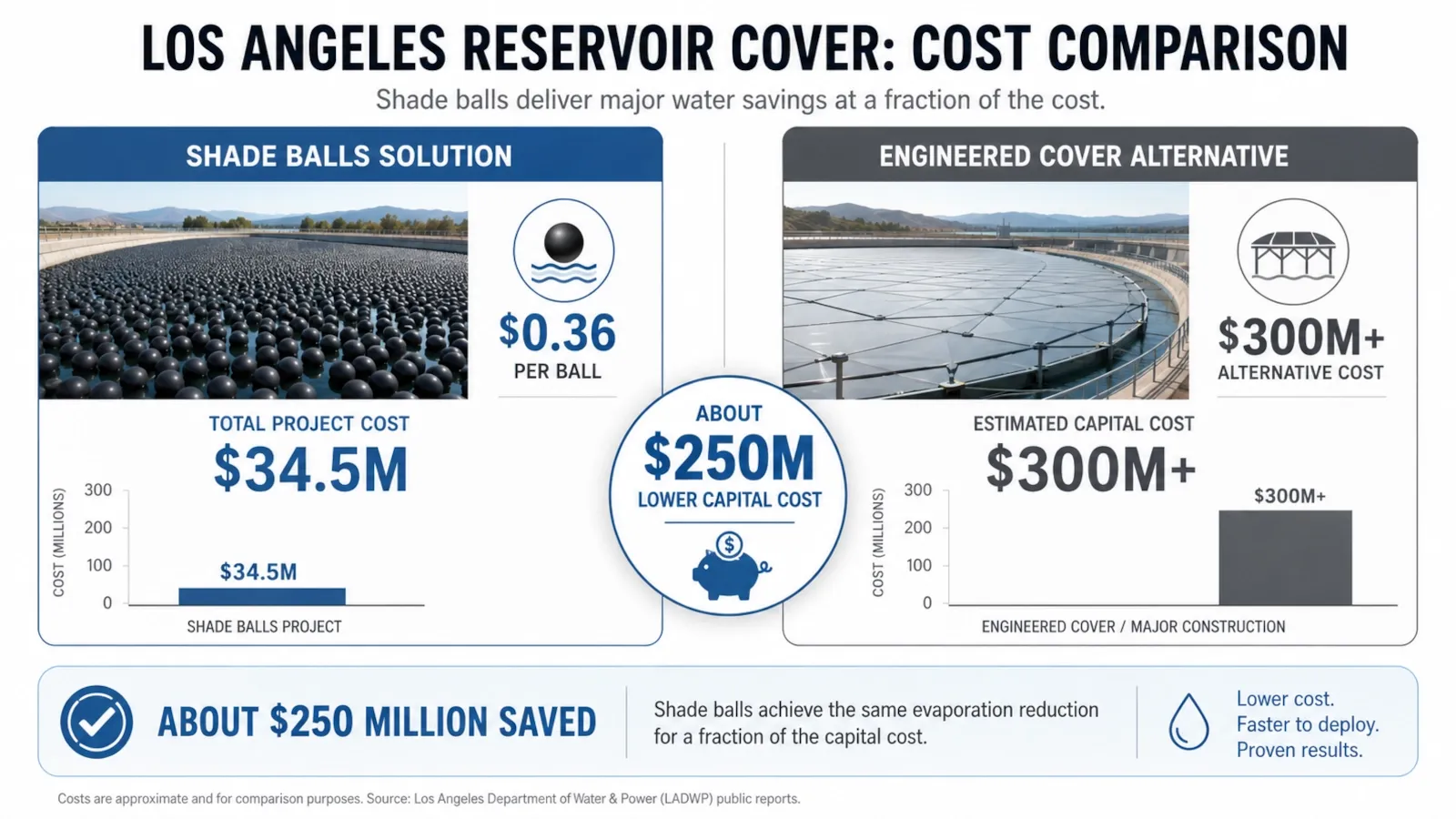
LADWP gives a unit cost of approximately $0.36 per ball for the Los Angeles Reservoir project.
At roughly 96 million balls, that places the shade-ball portion of the project at about $34.5 million.
The important comparison is the alternative engineering plan.
LADWP says the original approach would have involved major construction, including dividing the reservoir and installing enormous floating covers, with early estimates of at least $300 million. The utility has described the shade-ball approach as saving approximately $250 million in capital costs compared with the scale of alternatives considered.
This does not mean shade balls make sense for every reservoir. Their economics depend on the size of the reservoir, the water-quality problem, local weather, treatment infrastructure, material life, maintenance, and regulatory requirements.
For Los Angeles, the unusual combination of a very large open reservoir and a sunlight-sensitive water-quality problem made the comparison especially favorable.
Why balls instead of a roof, tarp, or solid floating cover?
A solid cover sounds simpler until the size of the reservoir is considered.
Covering roughly 175 acres with engineered structural or membrane systems can require extensive construction, anchoring, drainage, access systems, maintenance, and operational changes. LADWP had evaluated a much larger capital project that included dividing the reservoir and installing major floating covers.
Shade balls offered a different approach:
- rapid deployment;
- very little conventional construction on the reservoir surface;
- the ability to move with changing water levels;
- effective light reduction;
- easy removal in sections;
- a substantially lower initial capital cost than the alternatives LADWP was considering.
There are limitations. Shade balls do not form a sealed barrier. That is why they cannot perform every function of a solid reservoir cover.
Current LADWP documentation states that the shade balls and the ultraviolet treatment plant work together as part of the reservoir’s compliance strategy.
Where did the shade-ball idea come from?
The concept did not begin as a Los Angeles drought invention.
Plastic floating balls had already been used in other industries, including as “bird balls” on ponds near airport runways. Covering the water discourages birds from landing, reducing bird-strike risks around aircraft.
LADWP credits retired biologist Dr. Brian White with recognizing that a similar floating-ball concept could solve a water-quality problem by shading open reservoirs.
The utility began using shade balls in open reservoirs in 2008, years before the large 2015 Los Angeles Reservoir deployment made them internationally famous.
That history is another reason the common “California invented them during the drought to stop evaporation” story is incomplete.
Do shade balls have disadvantages?
Yes. A credible explanation should include them.
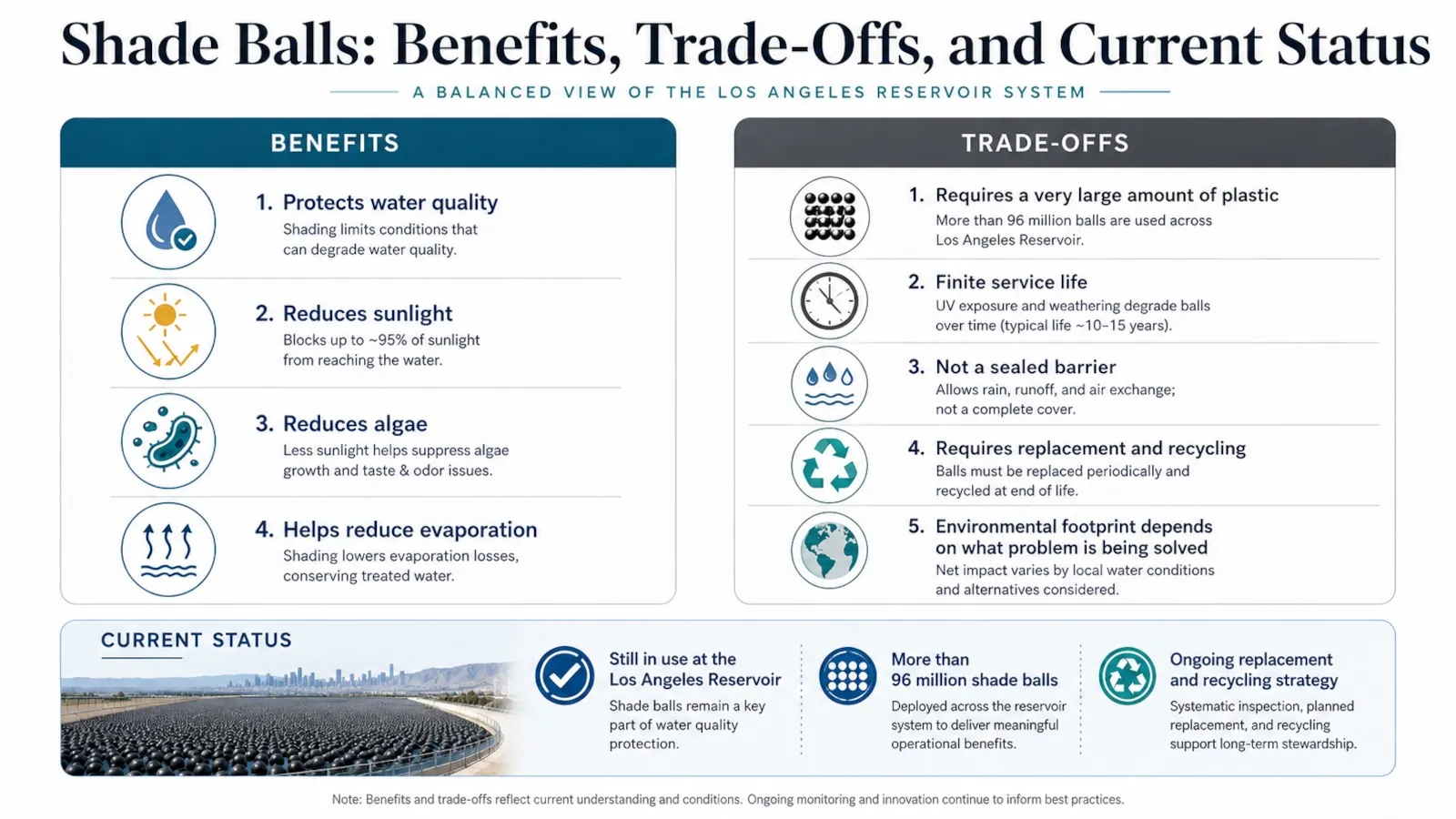
They require a very large amount of plastic
Tens of millions of HDPE spheres represent substantial material production. Even if the balls are recyclable at the end of their service life, manufacturing them has an environmental footprint.
They do not create a sealed cover
A layer of spheres blocks most sunlight but leaves small gaps and does not create the pathogen barrier of a continuous membrane. Other treatment measures are still required.
They have a finite service life
LADWP’s published FAQ describes a service life of at least 10 years, after which balls that lose structural integrity are to be removed and recycled. At the Los Angeles Reservoir, LADWP describes shade balls as a permanent strategy, with balls removed, recycled, and replaced as required — not as permanent individual pieces of plastic.
Wind has to be managed
The Los Angeles balls need water ballast because high winds can move unweighted spheres and expose sections of water.
Their sustainability depends on the problem being solved
A 2018 paper in Nature Sustainability examined the water footprint associated with manufacturing shade balls and questioned their sustainability when evaluated specifically as an evaporation-conservation technology.
That is a legitimate environmental consideration, but it should not be used to rewrite the purpose of the Los Angeles project. LADWP’s primary justification was drinking-water quality and regulatory compliance, with evaporation savings as an additional benefit.
A fair evaluation therefore has to compare the full system — material production, water saved, treatment chemicals avoided, infrastructure alternatives, regulatory requirements, replacement cycle, and water-quality benefits — rather than judging the balls on evaporation alone.
Are the shade balls still in the Los Angeles Reservoir?
Yes, according to the latest LADWP material reviewed for this article.
A 2025 LADWP booklet describes the Los Angeles Reservoir as still covered by more than 96 million shade balls and identifies the balls as part of the system used to safeguard water quality.
LADWP’s regulatory-compliance page also states that the reservoir was brought into compliance through the combination of shade balls deployed in 2015 and the Los Angeles Reservoir Ultraviolet Disinfection Plant, completed in January 2022.
One nuance matters here: LADWP also describes the individual balls as having a finite service life and a replacement/recycling program. Therefore, “installed in 2015” should not be interpreted to mean that every individual ball must remain untouched forever.
Common mistakes
Mistake 1: Saying the balls were installed mainly to stop evaporation
Evaporation reduction is real and substantial, but LADWP identifies the primary purpose as protecting water quality by blocking sunlight-triggered reactions.
The better explanation is: water quality first, evaporation as a major additional benefit.
Mistake 2: Assuming black was chosen because black keeps water cool
Black surfaces absorb solar radiation. The color choice is primarily about carbon black as a UV stabilizer, durability, and effective light blocking.
The thermal behavior of the full reservoir is more complex than the surface color of one ball.
Mistake 3: Calling them ordinary plastic balls
The reservoir balls are an engineered water-contact product made from specified HDPE and certified for drinking-water contact. A toy ball or generic plastic sphere is not automatically equivalent.
Mistake 4: Treating the balls as the entire water-treatment system
They are one component. Los Angeles also uses filtration, disinfection, continuous monitoring, operational controls, and ultraviolet treatment.
Mistake 5: Claiming the environmental debate proves the project was useless
The environmental footprint of manufacturing millions of plastic spheres is a real issue. But an analysis focused only on evaporation does not capture the project’s primary water-quality and regulatory purpose.
Security, privacy and safety notes
Shade balls are municipal infrastructure, not a consumer water-treatment product.
Do not place generic plastic balls into a drinking-water tank, cistern, pond, or pool and assume they are safe because Los Angeles uses shade balls. Materials intended for potable-water contact require appropriate formulation, certification, installation, and monitoring.
Do not enter, swim in, or attempt to access a secured drinking-water reservoir. The Los Angeles Reservoir is part of a public water-supply system, not a recreational swimming site.
Scientific and regulatory claims in this article are tied to the sources listed in the frontmatter and to the Los Angeles installation. Performance can differ in other climates, reservoir designs, water chemistries, and treatment systems.
Faster alternative
If you only need the essential facts, remember these seven:
| Question | Short answer |
|---|---|
| What are the black balls? | Shade balls made from HDPE |
| Why are they there? | Primarily to protect drinking-water quality by blocking sunlight |
| Why black? | Carbon black improves UV resistance and light blocking |
| How many? | More than 96 million at the Los Angeles Reservoir |
| Do they save water? | Yes; LADWP reports more than 300 million gallons per year |
| Are they safe? | The specific material was certified for drinking-water contact and is monitored by LADWP |
| Are they still there? | Yes, according to LADWP material current through 2025 and reviewed in 2026 |
The one-sentence version is:
Los Angeles uses more than 96 million black HDPE shade balls to block sunlight over a major drinking-water reservoir, primarily protecting water quality while also reducing algae, chlorine demand, and evaporation.
FAQ
Why were 96 million black balls released into the Los Angeles Reservoir?
They were deployed to cover the large reservoir surface and block sunlight. The primary purpose was to protect drinking-water quality by preventing sunlight-triggered chemical reactions and limiting algae growth. Reducing evaporation is an additional benefit.
What is the purpose of shade balls in a reservoir?
Shade balls reduce the amount of sunlight reaching the water. Depending on the application, that can help control sunlight-driven chemistry, algae, and evaporation. At the Los Angeles Reservoir, the principal role is water-quality protection.
Why are shade balls black?
They contain carbon black, which helps stabilize HDPE against ultraviolet degradation and gives the balls a longer outdoor service life. The dark material also blocks sunlight effectively.
How many shade balls are in the Los Angeles Reservoir?
LADWP’s 2025 material says the reservoir is covered by more than 96 million shade balls. The commonly cited deployment figure is 96 million.
How much does one shade ball cost?
LADWP has reported a cost of approximately 36 cents per ball for the Los Angeles Reservoir project, for a total shade-ball project cost of about $34.5 million.
Are shade balls safe for drinking water?
The specific shade balls used by LADWP were made for drinking-water contact and certified under NSF Standard 61 requirements. LADWP also performs ongoing water-quality monitoring. This does not mean any ordinary plastic ball is suitable for potable water.
Do shade balls actually reduce evaporation?
Yes. LADWP estimates that full shade-ball coverage can prevent up to about 90% of evaporation that would otherwise occur and reports savings of more than 300 million gallons per year at the Los Angeles Reservoir.
Are shade balls heavy?
Each Los Angeles Reservoir ball is relatively light as a plastic shell — about 40 grams — but LADWP adds roughly 200 grams of drinking water as ballast. That extra mass helps the balls resist strong wind gusts.
Can you swim in shade balls?
You should not. The Los Angeles Reservoir is secured drinking-water infrastructure, not a recreational swimming area. A dense layer of weighted floating balls also makes movement at the surface difficult and is not comparable to a recreational ball pit.
Are the shade balls still in the LA Reservoir?
Yes. LADWP’s 2025 documentation still describes the Los Angeles Reservoir as covered by more than 96 million shade balls.
Do the balls turn into microplastics?
LADWP states that its monitoring has found no evidence of shade-ball degradation into microplastics in the reservoir and no detected chemical leaching attributable to the balls. The utility also gives the balls a finite service life and describes removal, recycling, and replacement as they age. This is a site-specific monitoring claim, not a universal statement about all plastics in all environments.
Why not use a giant floating cover instead?
LADWP considered major floating covers and other construction. The alternatives it evaluated were far more expensive and operationally complex for a reservoir of this size. Shade balls provided a lower-cost way to block light, while ultraviolet treatment and other controls address requirements the balls cannot meet by themselves.
Where can you buy shade balls?
Industrial floating-cover balls are sold by specialist manufacturers, but the Los Angeles Reservoir product was specified for municipal drinking-water use. For potable-water applications, material certification and engineering requirements matter more than simply buying visually similar plastic balls.
Sources and methodology
This article prioritizes primary and technical sources.
The central facts — number of balls, reservoir size, purpose, material, dimensions, ballast, color, cost, evaporation estimates, safety monitoring, service life, and project history — come from the Los Angeles Department of Water and Power Shade Ball Facts, the LADWP 2025 Los Angeles Aqueduct Filtration Plant booklet, and LADWP’s Regulatory Compliance documentation.
Drinking-water regulatory context comes from the U.S. Environmental Protection Agency. Material-contact context is based on the scope of NSF/ANSI/CAN 61. The environmental trade-off section references the peer-reviewed 2018 Nature Sustainability paper, “The water footprint of water conservation using shade balls in California”.
Where LADWP documents use slightly different rounded ball counts across years, this article uses the current conservative wording “more than 96 million” rather than presenting an artificially exact live inventory.
Last tested
Fact-checked against:
- LADWP Shade Ball Facts and water-quality documentation
- LADWP 2025 Los Angeles Aqueduct Filtration Plant booklet
- LADWP Regulatory Compliance documentation
- U.S. EPA National Primary Drinking Water Regulations
- NSF/ANSI/CAN 61 standard information
- Nature Sustainability research on shade-ball water footprint
Last tested: 2026-08-08
Related guides
Carefully selected guides to help you understand the topic and complete the next useful step.