

A medicine can keep exactly the same molecular formula and still behave differently as a solid.
That is the unsettling lesson behind disappearing polymorphs: crystal forms that were once reproducible can become extremely difficult to obtain after another form appears. The most famous case involved ritonavir, an HIV protease inhibitor marketed as Norvir. In 1998, a new crystal form precipitated in the capsule formulation, dissolved much more poorly than the form used during development, and disrupted manufacturing.
The story is sometimes framed as “the crystal that could destroy all medicine.” That makes a compelling hook, but it overstates the science. A disappearing polymorph cannot suddenly erase every medicine. What the ritonavir crisis did demonstrate is more important: the solid-state arrangement of a drug can matter almost as much as its molecular identity, and a previously unknown crystal form can alter solubility, dissolution, stability, processing, and formulation.
This guide explains what disappearing polymorphs really are, why they can appear after years of reliable production, what happened to ritonavir, what scientists learned from the crisis, and how modern pharmaceutical development tries to reduce the risk.
Quick answer
A disappearing polymorph is a crystal form that has been made and characterized before but later becomes very difficult—or apparently impossible—to reproduce by the same method because a different crystal form begins to form instead.
Ritonavir became the classic pharmaceutical example in 1998. A more thermodynamically stable crystal form, Form II, appeared in the marketed capsule formulation. It was substantially less soluble than the original Form I, so capsules failed dissolution specifications and the original formulation could no longer be manufactured reliably.
The molecule had not changed into a different drug. Its crystal packing had changed. Later research showed that Form I had not vanished from physical possibility: it could be recovered under specially controlled conditions. The real problem was loss of reliable control over which solid form crystallized.
When this explanation is useful
This guide is for readers who want to understand:
- what a disappearing polymorph is in plain language;
- why the same molecule can form different crystals;
- why one crystal form can dissolve differently from another;
- what happened during the 1998 ritonavir manufacturing crisis;
- why thermodynamics and kinetics can point toward different crystal forms;
- how seed crystals influence nucleation;
- whether the original ritonavir Form I truly disappeared forever;
- whether a similar problem could affect other medicines;
- how modern drug development searches for and controls polymorphs.
This is a solid-state chemistry and pharmaceutical science explainer, not a guide to using ritonavir or changing HIV treatment. If you take ritonavir or another prescription medicine, follow the formulation and medical advice provided by your healthcare professional.
Before you start
Four ideas make the rest of the story much easier to understand.
- Molecule: a specific arrangement of atoms connected by chemical bonds.
- Crystal: a solid in which molecules or atoms are arranged in an ordered repeating structure.
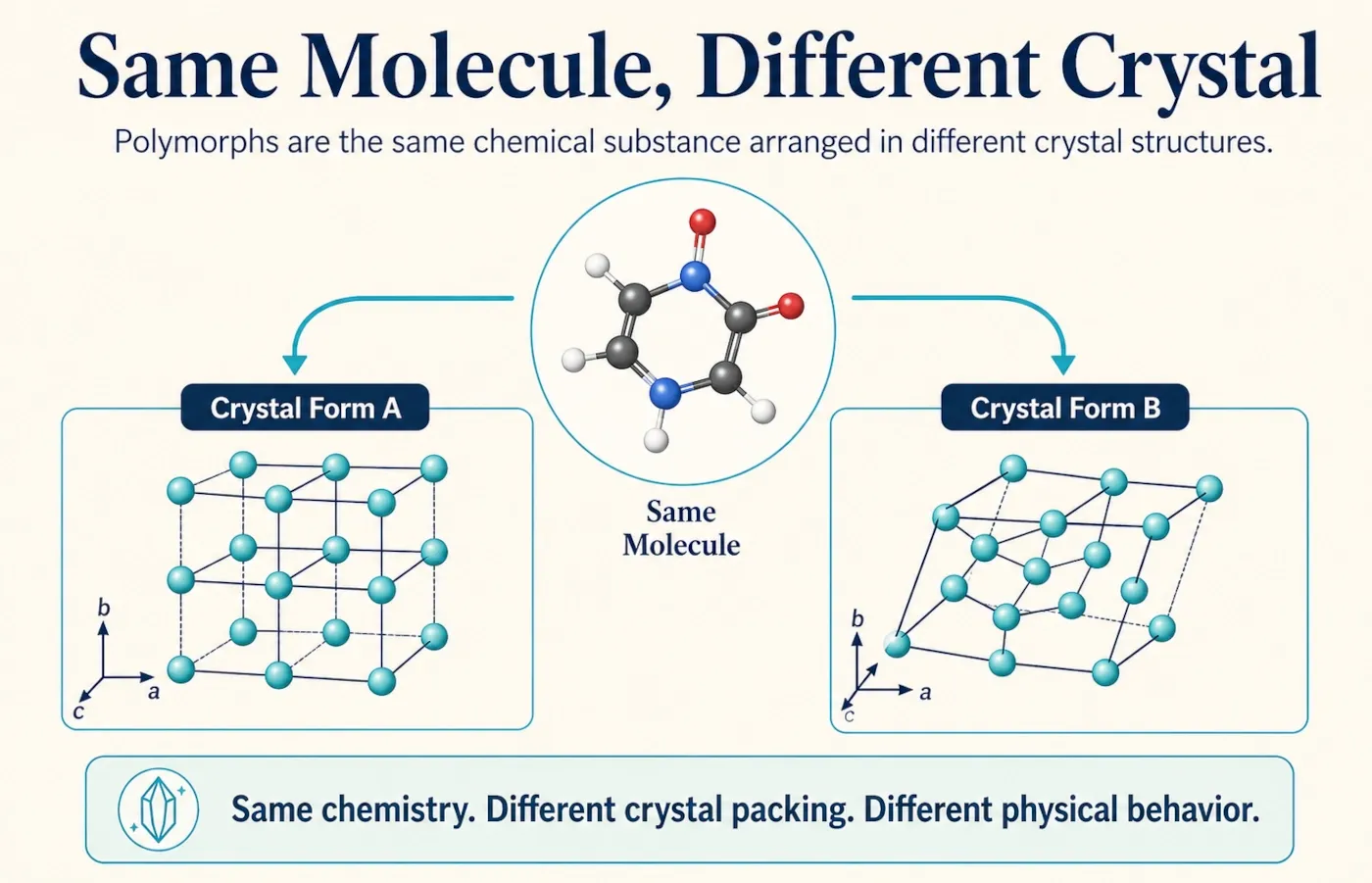
- Polymorph: one of two or more different crystal structures that can be made from the same chemical substance.
- Nucleation: the first formation of a sufficiently organized microscopic cluster from which a crystal can grow.
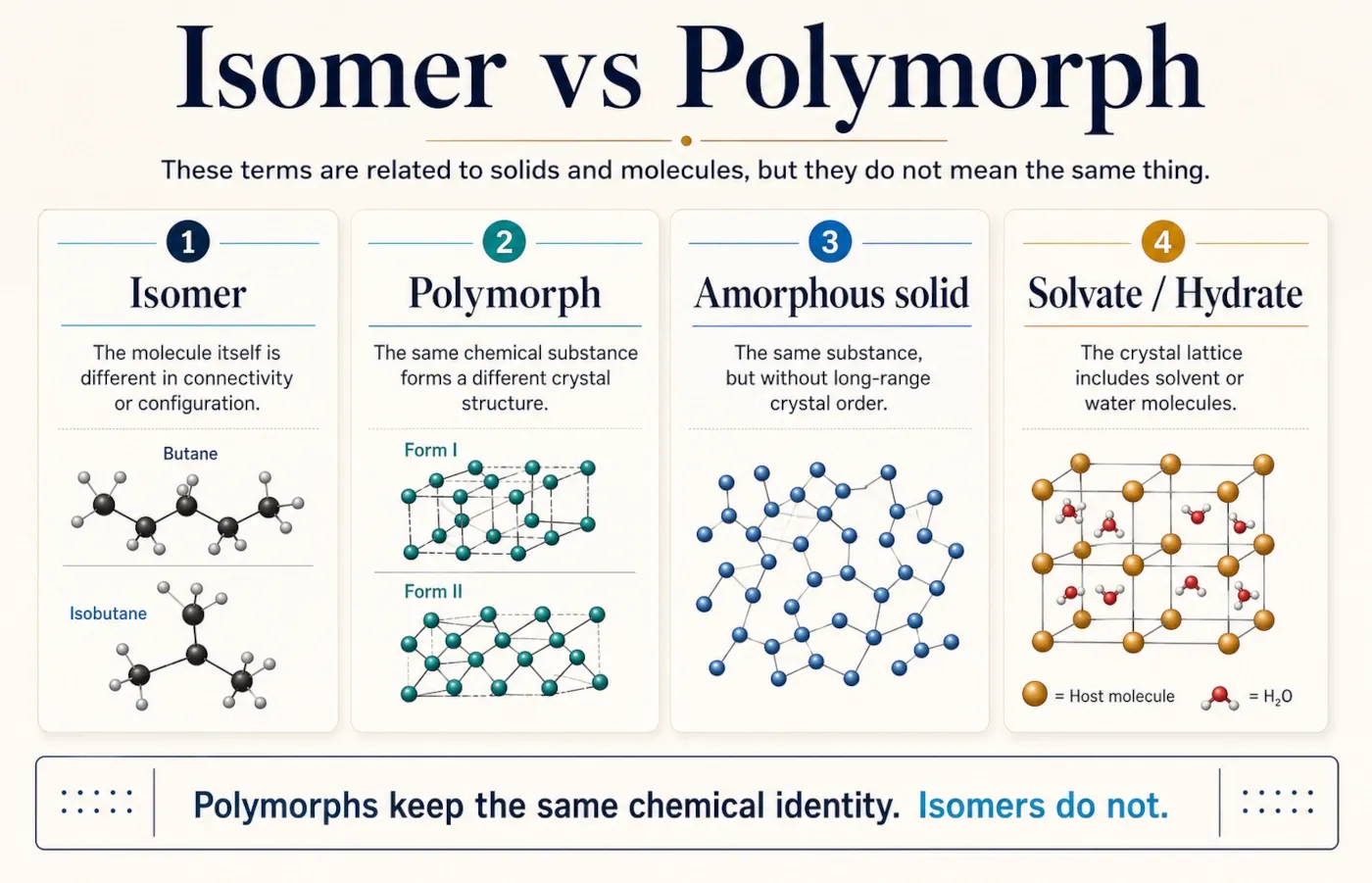
One more distinction matters: a polymorph is not the same thing as an isomer. Isomers differ in molecular connectivity or configuration. Polymorphs have the same chemical species but pack differently in the solid state.
What happened to ritonavir in 1998?
Ritonavir was introduced in 1996 as an HIV protease inhibitor. During development and early commercial manufacture, the known crystalline material was what later became known as Form I.
Then, in the summer of 1998, some batches of Norvir capsules began failing the approved dissolution test. The problem was not that the ritonavir molecule had decomposed into a completely different active ingredient. Investigators found a new crystalline form of ritonavir—Form II—inside the formulation.
The event became serious because the new form had very different solid-state properties.
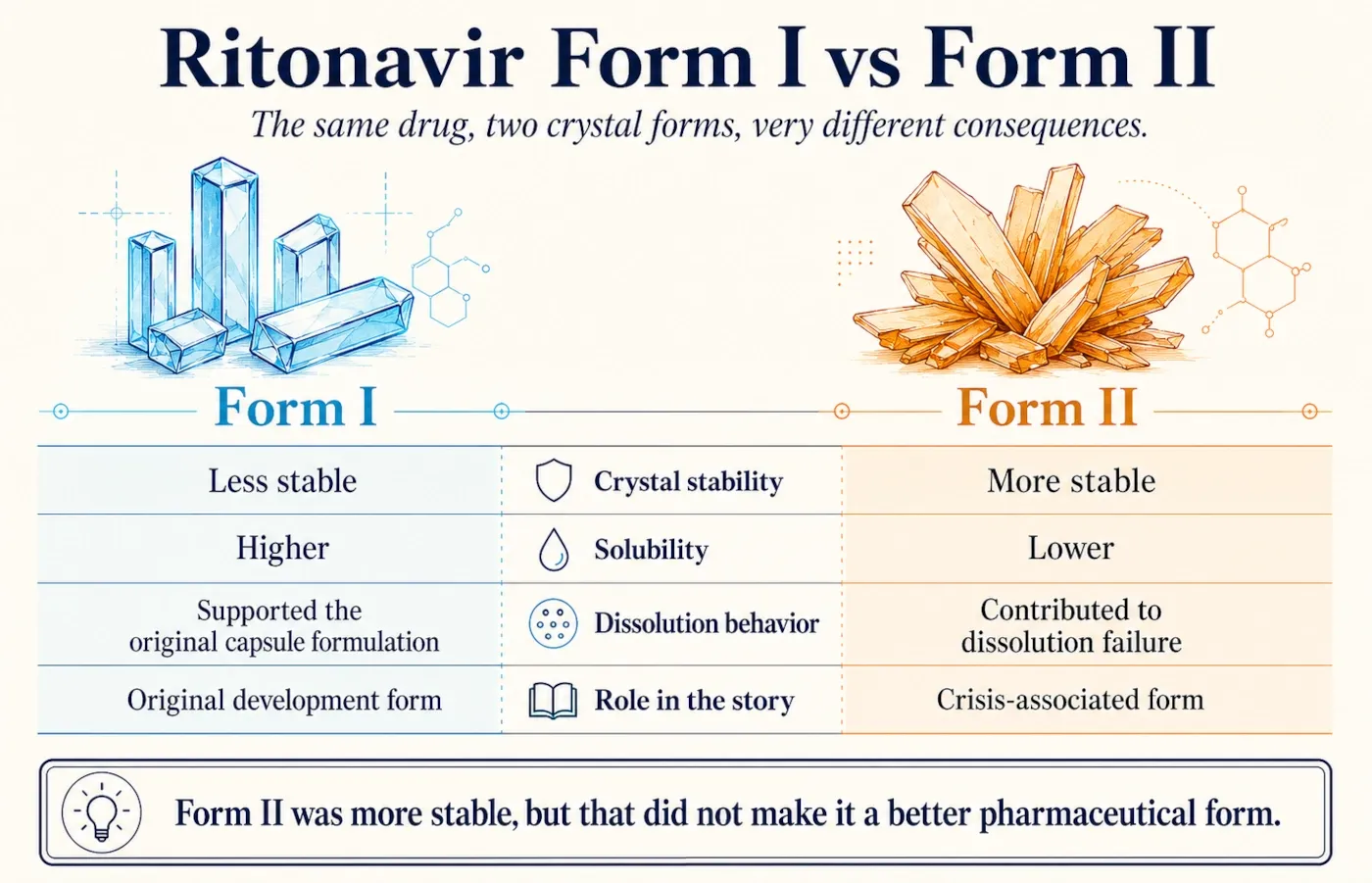
The original Abbott scientific reports describe Form II as a more stable crystal packing arrangement with substantially lower solubility than Form I. A later high-throughput study reported that Form II was less than half as soluble as Form I under the conditions considered. Poorer solubility translated into slower dissolution of the marketed dosage form, creating a product-performance problem.
The European Medicines Agency reported on 28 July 1998 that recent batches of Norvir hard capsules had failed dissolution testing and that Abbott’s investigation had identified a new crystalline form that could affect dissolution and possibly subsequent absorption. The capsule supply was threatened, while oral solution remained available as an alternative.
The crisis can be summarized like this:
| Stage | What happened |
|---|---|
| 1996 | Ritonavir/Norvir entered the market. |
| Before 1998 | Development and manufacture relied on the known Form I solid form. |
| Summer 1998 | Some capsule batches failed dissolution specifications. |
| Investigation | A new crystal form, Form II, was identified. |
| Key difference | Form II was more stable and much less soluble than Form I. |
| Manufacturing consequence | The original capsule formulation could no longer be produced reliably. |
| Patient-supply response | Oral solution provided an interim alternative while a formulation compatible with the new polymorphic reality was developed. |
| Long-term lesson | Pharmaceutical solid-form screening and control received much greater attention. |
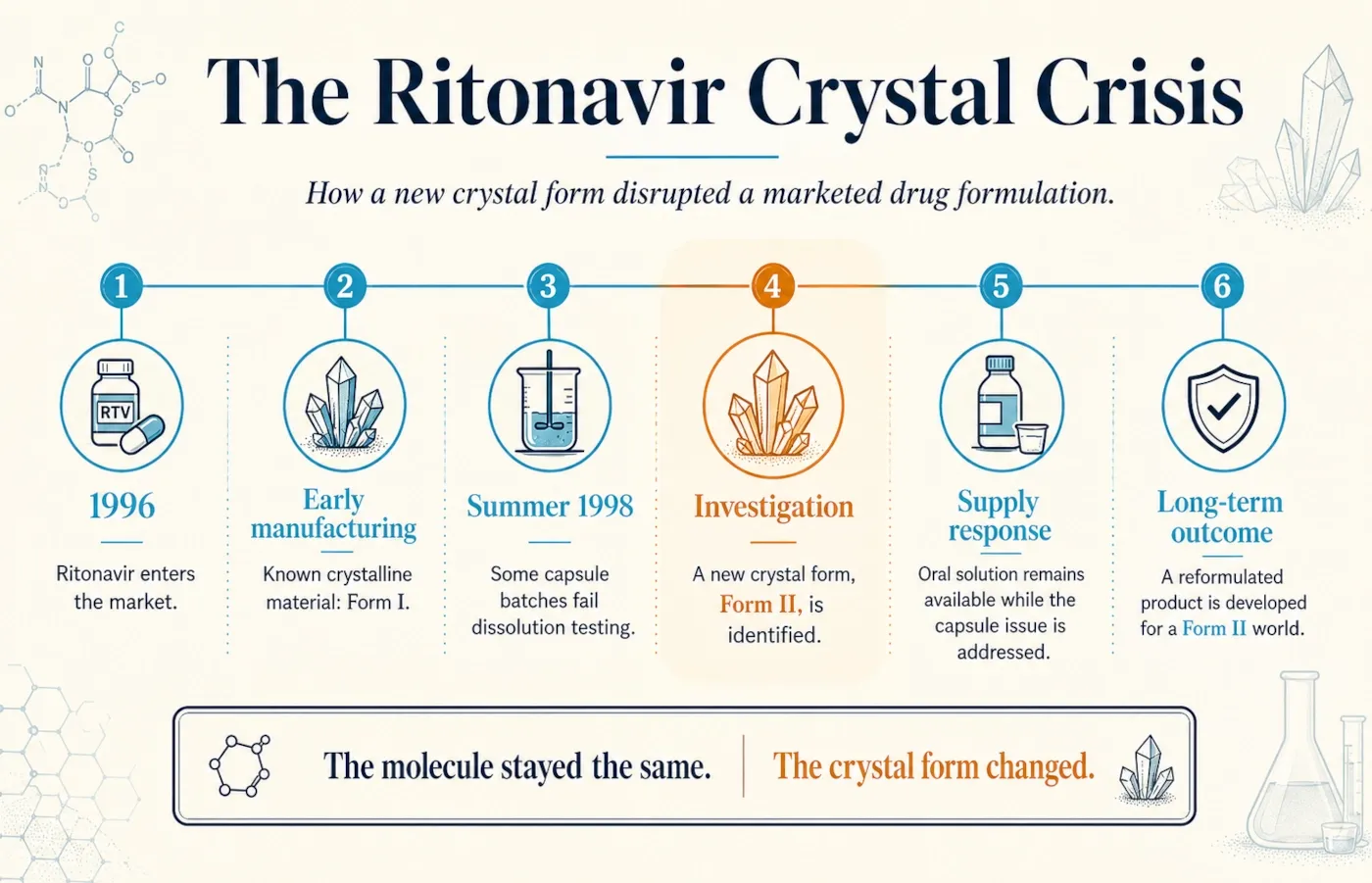
The crucial point is that the chemical identity remained ritonavir. What changed was the way ritonavir molecules arranged themselves in the solid crystal.
What is a crystal polymorph?
Imagine having one type of building block and arranging it into two different repeating structures. The blocks are identical, but the finished structures are not.
Molecular crystals can work the same way.
A compound may crystallize so that its molecules adopt one repeating arrangement, or it may pack into another arrangement with different intermolecular contacts, molecular conformations, symmetry, density, and lattice energy.
Those different crystal structures are polymorphs.
A useful shorthand is:
Same chemical substance. Different crystal structure. Potentially different physical properties.
This is why chemical identity alone does not fully describe a pharmaceutical solid. The solid form can influence how the material behaves during manufacturing and after administration.
The FDA’s guidance on pharmaceutical solid polymorphism notes that polymorphic forms can differ in properties including apparent solubility, dissolution rate, density, mechanical behavior, and stability. Those differences can affect processing, manufacturing, dissolution, bioavailability, and product quality.
Polymorph vs isomer: they are not the same thing
These concepts are easy to confuse because both can produce substances with different behavior.
| Concept | What changes? | Chemical identity |
|---|---|---|
| Isomer | Connectivity or spatial configuration within the molecule | Different molecular structure despite the same molecular formula |
| Polymorph | Packing and sometimes molecular conformation within a crystal lattice | Same chemical substance in a different crystal structure |
| Amorphous form | Long-range crystal order is absent | Same chemical substance, non-crystalline solid |
| Solvate | Solvent molecules are incorporated into the crystal lattice | Multicomponent crystalline solid |
| Hydrate | Water molecules are incorporated into the crystal lattice | A specific type of solvate |
Ritonavir is especially interesting because Forms I and II are described as conformational polymorphs. The ritonavir molecules adopt different conformations in the two crystal structures, and those conformational differences participate in different crystal packing and hydrogen-bonding networks.
Why crystal form matters in medicine
For a tablet or capsule to deliver an active pharmaceutical ingredient, the solid usually has to leave its crystal environment before individual molecules can dissolve.
That means the strength and organization of the crystal lattice matter.
Different polymorphs can differ in:
- solubility — how much material can dissolve under particular conditions;
- dissolution rate — how quickly solid drug enters solution;
- bioavailability — in some formulations, changes in dissolution can affect how much drug becomes available to the body;
- thermodynamic stability — which solid form is favored at a given temperature and pressure;
- physical stability — whether one form converts into another during storage or processing;
- melting behavior;
- particle shape and density;
- flowability and compactibility;
- hygroscopicity;
- filtration and drying behavior;
- manufacturability.
A more stable crystal is not automatically a “better” pharmaceutical form.
For ritonavir, the more stable Form II formed stronger stabilizing interactions in its lattice and was much less soluble than Form I. In the formulation used at the time, that lower solubility was a serious disadvantage.
This does not mean every more-stable polymorph of every drug will have clinically important lower bioavailability. The effect depends on the substance, formulation, dose, dissolution behavior, permeability, manufacturing process, and other factors. That is why regulators evaluate polymorphism in the context of the finished drug product rather than treating all polymorphic differences as equivalent.
What is a disappearing polymorph?
The term became widely known after Jack Dunitz and Joel Bernstein’s 1995 review “Disappearing Polymorphs.”
A later 2015 review gave a practical definition: a disappearing polymorph is a crystal form that has been prepared and experimentally established at least once, but later attempts using the same procedure produce a different form, either alone or mixed with the old form. Often the new form eventually dominates.
The word “disappearing” is therefore slightly misleading.
It does not mean:
- the old structure has been erased from nature;
- the molecule can no longer adopt that structure under any imaginable condition;
- a physical law has changed.
It means:
The crystallization landscape has changed in practice: a form that used to be reproducible is no longer reliably obtained under the conditions that once produced it.
That distinction is essential to understanding ritonavir.
Why do polymorphs “disappear”?
There is no single universal mechanism for every disappearing polymorph. But the phenomenon is best understood by separating thermodynamics from kinetics.
Thermodynamics: which crystal is more stable?
At a given set of conditions, crystal forms differ in free energy.
The lower-energy form is thermodynamically favored. If two polymorphs can exist under the same conditions, one may be more stable while the other is metastable.
A metastable crystal can still persist for a very long time. Thermodynamic preference tells us where a system tends to go—not necessarily how fast it will get there.
Kinetics: which crystal can form first?
Crystallization requires a new ordered phase to begin.
That first step—nucleation—can be difficult. A form that would ultimately be more stable may have a high nucleation barrier, meaning that the first viable nucleus is statistically unlikely to appear.
A less-stable polymorph may therefore crystallize first because its nucleation pathway is kinetically easier.
This is a classic example of thermodynamics and kinetics pulling in different directions:
thermodynamics → favors the lower-energy final state
kinetics       → determines which state is accessible on a practical timescale
The nucleation barrier: why the “better” crystal may stay hidden
Making a tiny crystal nucleus is not simply a matter of a few molecules touching.
Creating a new crystal introduces an interface between the nucleus and its surroundings. Very small clusters can be energetically unfavorable and disappear before becoming stable enough to grow.
A crystal form can therefore remain elusive for years even if it is thermodynamically more stable.
Eventually, a rare combination of concentration, solvent, temperature, impurity, surface, mechanical stress, molecular conformation, or random fluctuation may provide the conditions needed for that nucleus to appear.
Metastability: why the old form can survive for years
A metastable polymorph is not “unstable” in the everyday sense of instantly transforming.
If the kinetic barrier separating it from a lower-energy form is large, the metastable state can be long-lived and reproducibly manufactured.
That is exactly why the later appearance of a more stable form can be so disruptive. The previous manufacturing history may create confidence that the observed crystal form is the only practically relevant one, even though the broader solid-form landscape contains structures that have not yet nucleated.
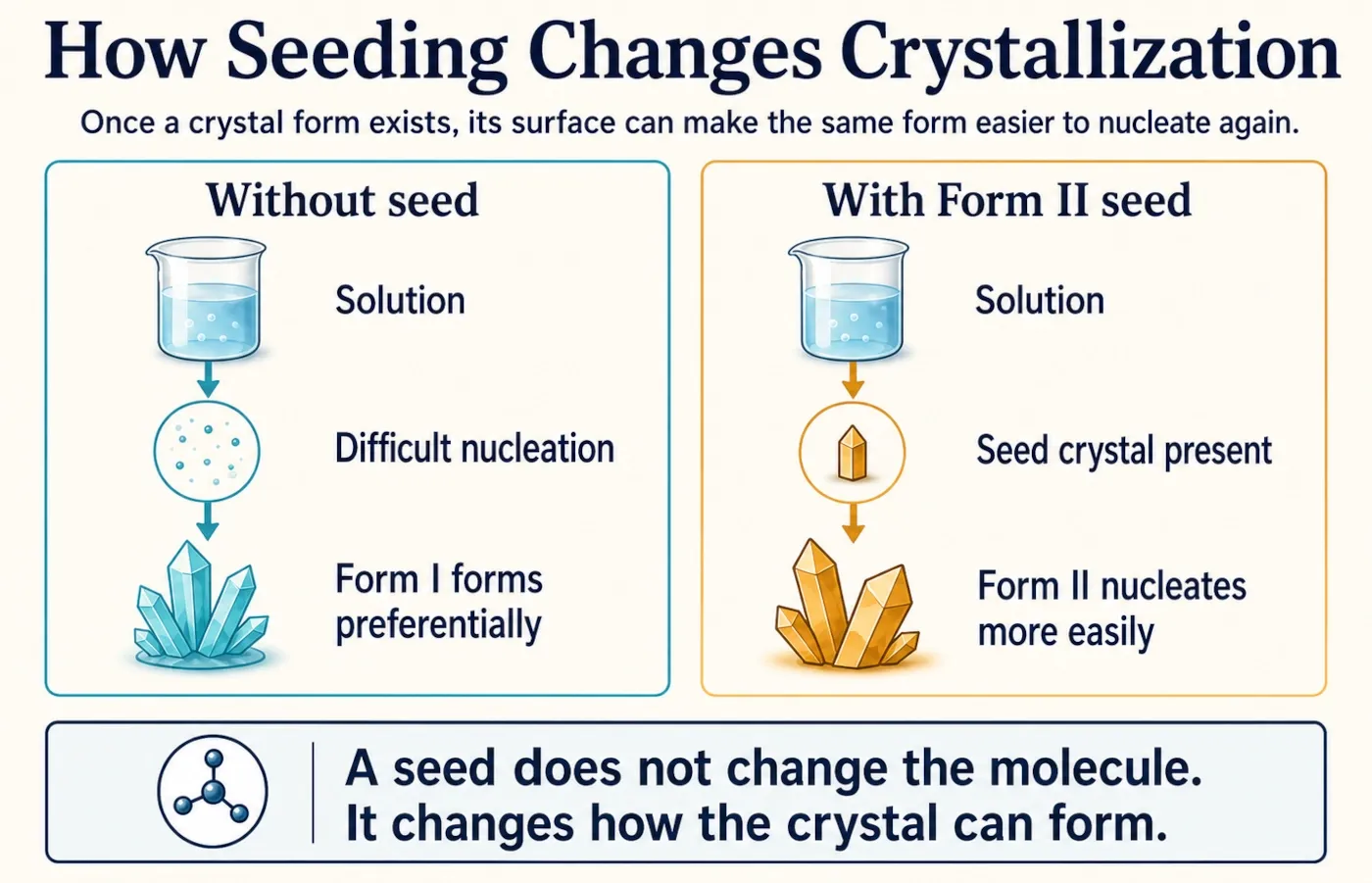
Seeding: why one successful nucleus can change future crystallizations
Once a crystal exists, new molecules no longer have to organize themselves from scratch.
The crystal surface can provide a template onto which compatible molecules attach. This is crystal seeding.
A seed can therefore reduce the effective barrier to forming the same crystal structure.
In simplified terms:
BEFORE THE NEW FORM EXISTS

solution or formulation
        ↓
new form has a difficult nucleation pathway
        ↓
old form forms reproducibly


AFTER THE NEW FORM HAS BEEN NUCLEATED

new-form crystal surface is available
        ↓
same lattice can be templated more easily
        ↓
new form becomes much easier to reproduce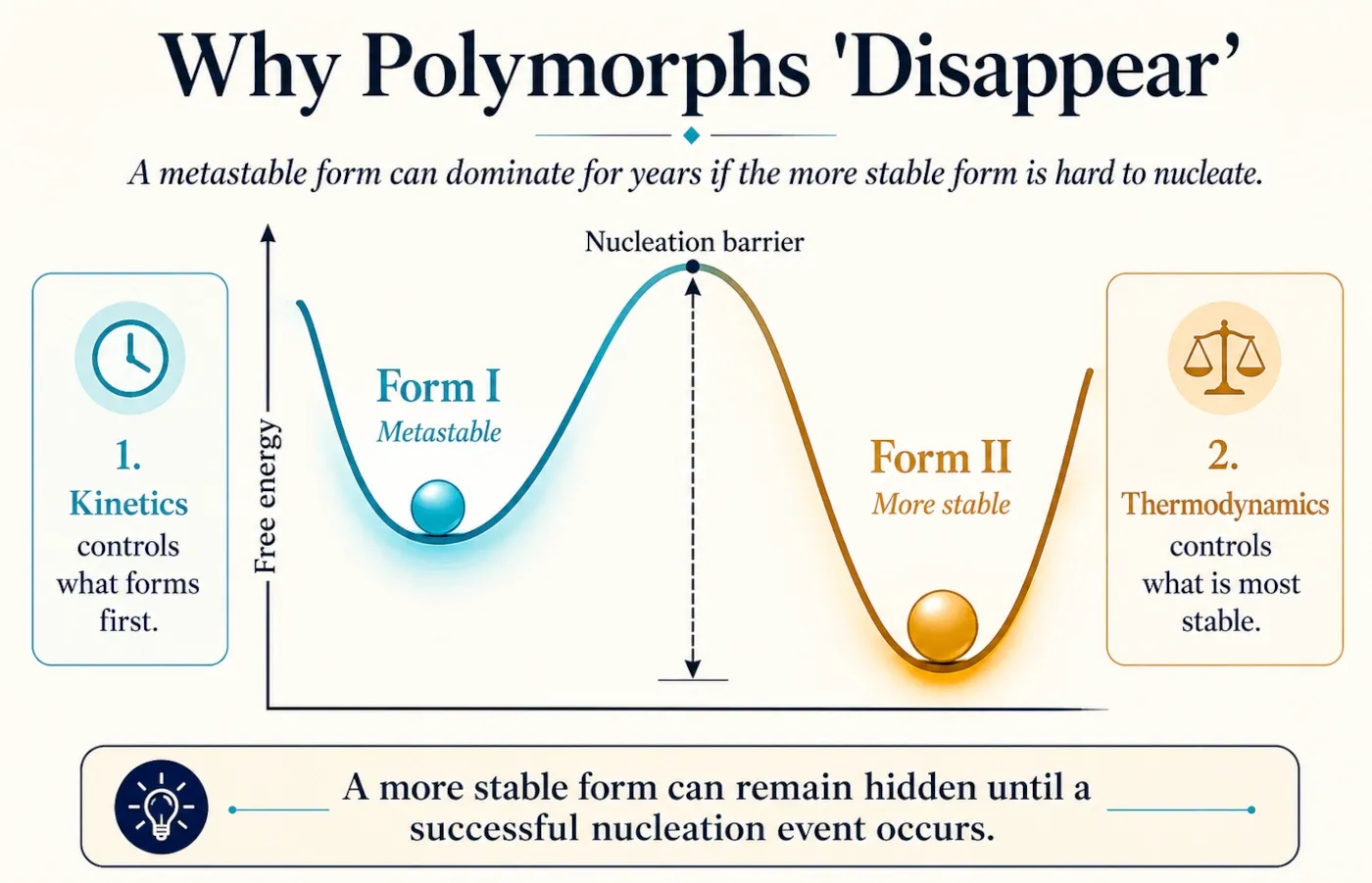
This simplified model captures why a more stable but reluctant crystal form can be absent for years and then suddenly become common.
The mechanism, step by step
The ritonavir story is easiest to understand as a sequence.
1. Form I was the accessible solid form
During development, extensive work identified one crystalline form of ritonavir. Attempts to find alternatives had not revealed the later Form II.
This did not prove that Form I was the lowest-energy crystal structure possible. It proved only that Form I was the solid form scientists had found and could reproduce.
2. Form II eventually nucleated
In 1998, a different crystal form appeared.
Bauer and colleagues later concluded that Form II had a more stable packing arrangement and proposed that its sudden emergence involved an unusual combination of high supersaturation and probable heterogeneous nucleation, potentially involving a degradation product.
The exact first triggering event was not conclusively established.
3. Form II had a strong thermodynamic advantage
Once formed, Form II was more stable than Form I under the relevant conditions.
Its lattice was also associated with much lower solubility.
That created a strong reason for the system to favor Form II once the kinetic hurdle to forming it had been overcome.
4. Existing crystals could seed more Form II
Once Form II crystals existed in laboratories or manufacturing environments, they could in principle act as seeds for subsequent crystallization.
Dust, equipment surfaces, scratches, impurities, residual particles, or deliberate seeding can all influence heterogeneous nucleation.
5. The old process stopped giving the old result reliably
This is the defining disappearing-polymorph behavior.
The problem was no longer simply “a batch contains an impurity.” The unwanted solid form was still ritonavir, and attempts to remove it from the environment did not restore reliable production of the original formulation.
Why was ritonavir Form II such a problem?
The counterintuitive part is that Form II was more stable.
That sounds beneficial until we connect stability to dissolution.
For a molecule to dissolve, it must escape the solid lattice. A strongly stabilized crystal lattice can make that energetically less favorable.
For ritonavir, the chain of consequences was approximately:
more stable Form II crystal
        ↓
lower solubility than Form I
        ↓
poorer dissolution in the capsule formulation
        ↓
failure to meet dissolution specifications
        ↓
unacceptable manufacturing and product-performance risk
The original reports did not describe a molecule that had stopped being pharmacologically ritonavir. They described a solid form whose physical behavior was incompatible with the existing formulation and manufacturing assumptions.
That distinction is the entire scientific point.
How could one crystal spread the problem?
The idea of crystals behaving almost like a contaminant sounds dramatic, but crystal seeding is real.
A microscopic crystal can provide a surface with the correct structural arrangement for additional molecules to join. If particles are transported to another vessel, surface, laboratory, or production area, they can potentially change subsequent nucleation behavior.
What we know
- Form II appeared unexpectedly during ritonavir manufacturing.
- Once Form II was present, controlling the solid form became extremely difficult.
- Abbott scientists investigated heterogeneous nucleation and developed highly sensitive approaches to detect seeds.
- Crystal seeds and foreign surfaces can influence nucleation.
- Form II was eventually encountered across multiple manufacturing and development contexts.
What remains a hypothesis
The exact first event that produced ritonavir Form II in 1998 was never established with certainty.
Popular retellings sometimes state that scientists physically carried Form II crystals from one facility to another on their clothes, thereby “infecting” the new site. Transport of seed crystals by personnel or environmental contamination is scientifically plausible and has been discussed, but it should not be presented as conclusively proven history.
The original Abbott account explicitly acknowledged uncertainty about the initiating cause. The 2001 scientific analysis proposed a likely heterogeneous-nucleation mechanism involving a highly supersaturated solution and a probable degradation product.
The careful conclusion is therefore:
Seeding helps explain why Form II could become easier to reproduce once it existed, but the precise origin and transmission route of the first Form II event cannot be reconstructed with certainty.
Did ritonavir Form I really disappear forever?
No.
This is one of the most important updates missing from simplified versions of the story.
A disappearing polymorph is a reproducibility problem, not proof of permanent physical extinction.
In 2003, researchers used high-throughput crystallization to explore roughly 2,000 ritonavir crystallization experiments. They identified five distinct crystal forms or solid phases in the broader landscape and described an unusual route in which a formamide solvate converted through a hydrate phase and ultimately generated needle-like Form I.
In other words, Form I could be obtained again.
Research published in 2024 went further. One study demonstrated that Form I and Form II could be produced consistently under different mechanochemical ball-milling environments. Another examined how solvent selection affects the crystallizability and polymorphic selectivity of the “disappeared” Form I.
So the scientifically accurate statement is:
Form I became extraordinarily difficult to reproduce using the original manufacturing route after Form II appeared; it did not become impossible for matter to form Form I under every condition.
This matters because “disappearing” is a description of experimental behavior, not literal annihilation.
How was the ritonavir crisis solved?
There was no magic procedure that simply restored the pre-1998 world.
The immediate priority was maintaining treatment availability.
During the capsule manufacturing problem, ritonavir remained available as an oral solution. Regulatory records show that the original semi-solid capsule was removed from the market, while Abbott modified a soft-elastic capsule formulation so that product performance could be maintained in the presence of the new polymorphic reality.
The long-term solution was therefore not:
eliminate Form II everywhere and return permanently to the old process.
It was closer to:
understand Form II, control the formulation, and design manufacturing that remained reliable even though Form II existed.
That is a deeper engineering lesson. Robust pharmaceutical development cannot depend on the assumption that an inconvenient solid form will never appear.
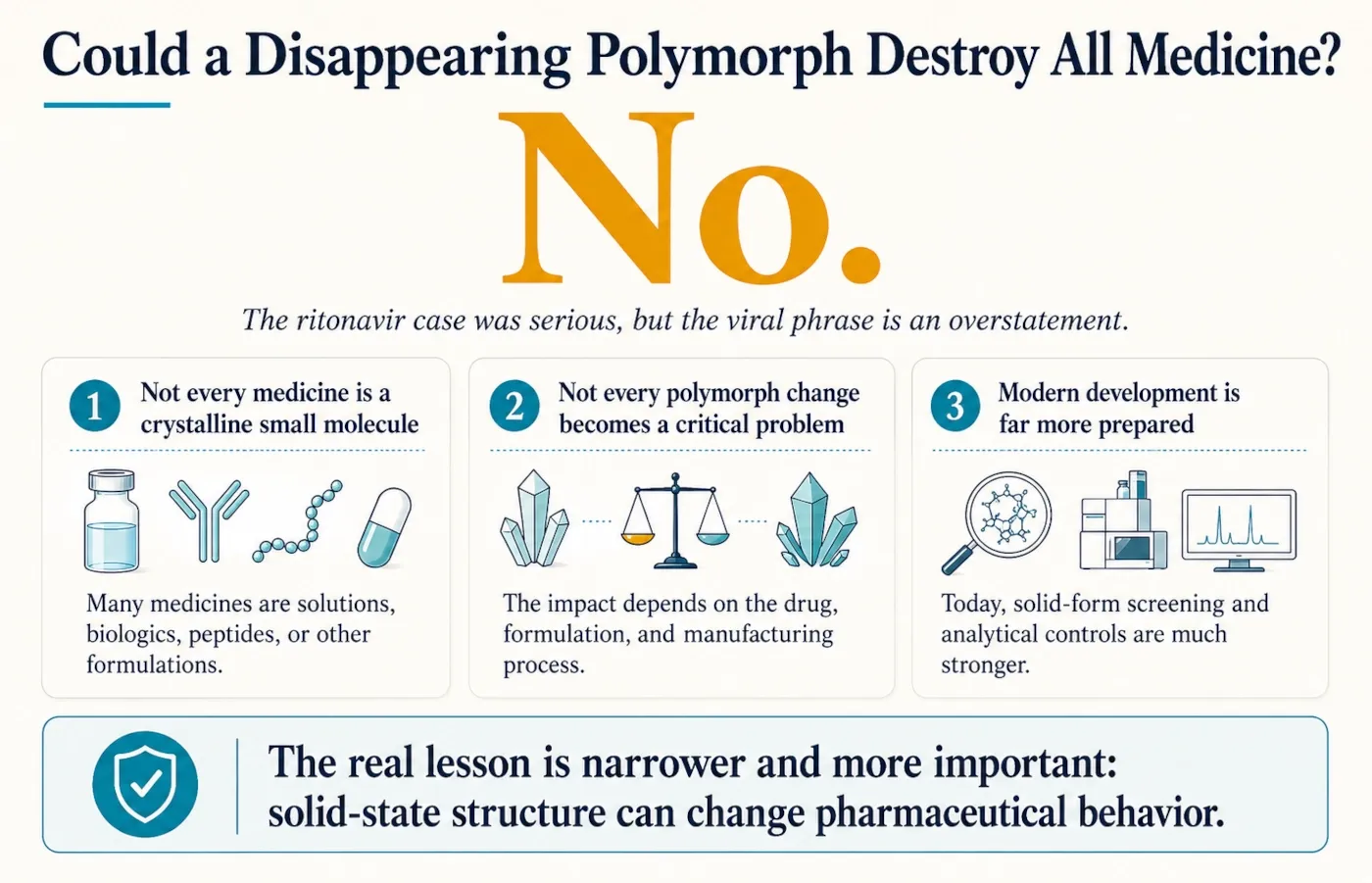
Could a disappearing polymorph destroy all medicine?
No.
The phrase is effective as a thought experiment, but it is scientifically misleading if taken literally.
First, not every medicine is a small-molecule crystalline solid. Modern medicine includes solutions, suspensions, amorphous formulations, biologics, peptides, nucleic-acid products, and many other dosage forms and molecular classes.
Second, even when an active pharmaceutical ingredient is polymorphic, different forms do not automatically create a clinically important problem. The practical impact depends on how strongly the forms differ and how sensitive the formulation is to those differences.
Third, pharmaceutical development now places far greater emphasis on solid-form screening, analytical characterization, manufacturing controls, stability studies, and risk assessment than it did when ritonavir entered the market.
But the exaggerated question contains a real scientific warning:
A previously unknown crystal form can still create a serious development or manufacturing problem if it has unfavorable properties and appears after a process has been built around another form.
The probability may be low, but the consequences can be expensive and, for important medicines, potentially disruptive to supply.
How drug companies look for polymorphs today
The ritonavir case became a landmark example of why finding and controlling solid forms early matters.
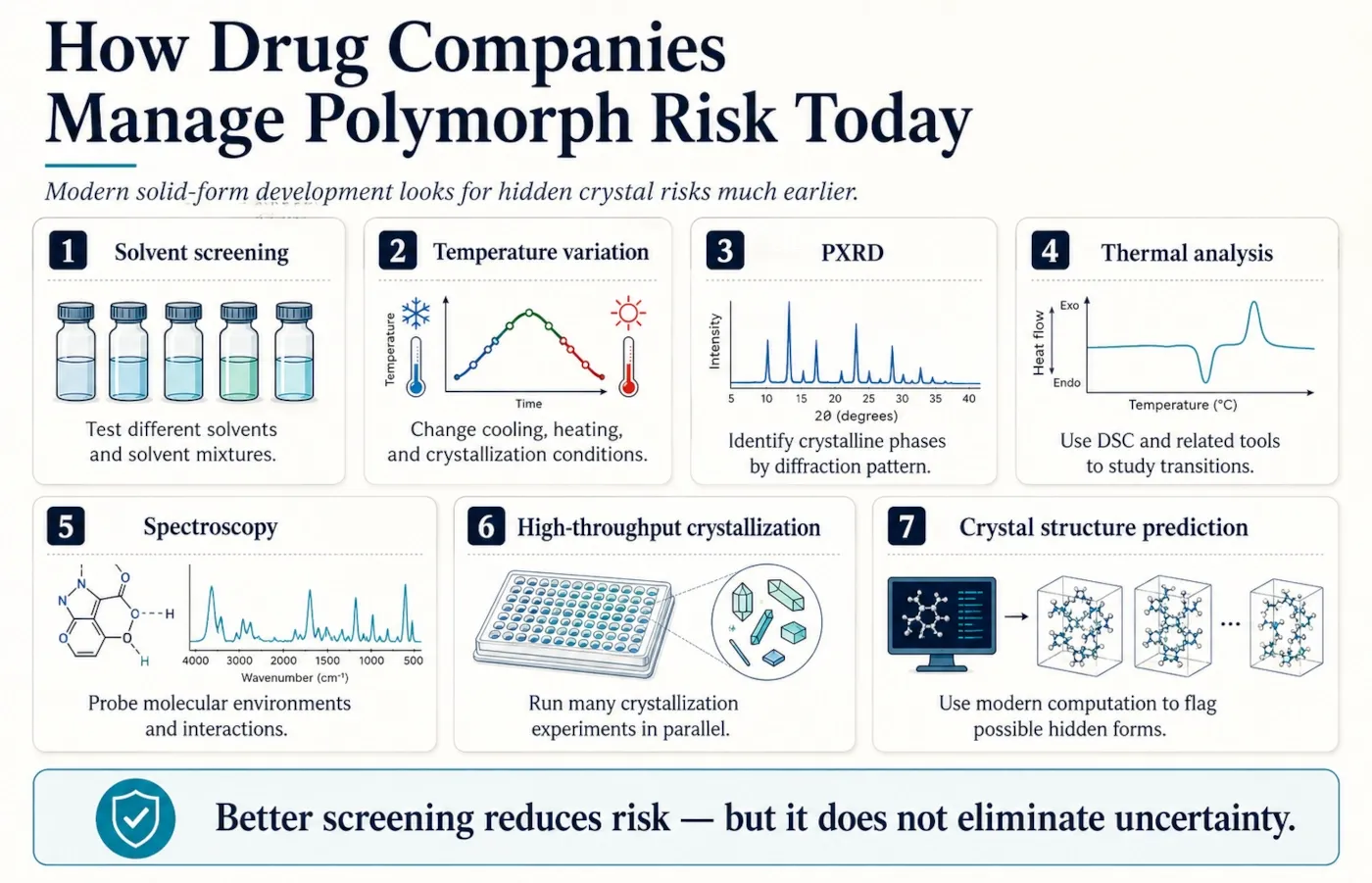
Modern solid-form development can combine experimental and computational approaches.
Polymorph and solid-form screening
Scientists vary conditions such as:
- solvent and solvent mixtures;
- temperature;
- cooling and evaporation rate;
- concentration and supersaturation;
- pH, where relevant;
- water activity;
- antisolvent addition;
- impurities and additives;
- seed crystals;
- stirring and mechanical history;
- drying conditions;
- milling and other forms of mechanical stress.
The goal is not simply to make crystals. It is to map as much of the compound’s accessible solid-form landscape as practical.
Powder X-ray diffraction
Powder X-ray diffraction, or PXRD, provides a highly characteristic fingerprint of a crystalline phase and is one of the central tools for distinguishing solid forms.
Single-crystal X-ray diffraction
When suitable crystals can be obtained, single-crystal X-ray diffraction can reveal the three-dimensional arrangement of molecules in the lattice.
Thermal analysis
Techniques such as differential scanning calorimetry (DSC) and thermogravimetric analysis help characterize melting, transitions, desolvation, and other thermal events.
Spectroscopy
Infrared, Raman, solid-state NMR, and related techniques can detect differences in local molecular environments and intermolecular interactions.
Microscopy
Crystal habit, morphology, nucleation, and phase changes can be examined visually and with specialized microscopy.
High-throughput crystallization
Instead of testing a small number of conditions sequentially, automated and parallel screening can explore hundreds or thousands of combinations.
The 2003 ritonavir study is a striking example: a broad screen exposed much more solid-form diversity than the two forms known during the original crisis.
Crystal structure prediction
Computational crystal structure prediction (CSP) attempts to identify plausible crystal packings and compare their relative energies.
A 2025 retrospective study revisited ritonavir using modern CSP and concluded that the method would have identified the existence of a more stable, then-undiscovered Form II at room temperature and would have flagged its combination of structural distinctiveness and formulation risk as severe enough to justify additional investigation.
That is a striking result—but it should be interpreted correctly. It does not mean modern computation can guarantee that every polymorph of every drug will be predicted or experimentally realized.
The 2015 review of disappearing polymorphs makes the broader limitation clear: one can establish which known form is most stable, but it is much harder to prove that no lower-energy, practically accessible form remains undiscovered.
Other examples of disappearing polymorphs
Ritonavir is the most famous pharmaceutical case, but it is not the only one.
Ranitidine hydrochloride
The 2015 review describes a clear historical disappearing-polymorph episode involving ranitidine hydrochloride.
A manufacturing batch prepared in 1980 produced a previously unobserved crystal form, later called Form 2. Subsequent batches contained increasing amounts of Form 2, and the process that had previously produced Form 1 stopped doing so reliably.
Unlike the ritonavir case, the new form offered some processing advantages, including improved filtration and drying characteristics. The example is useful because it shows that the arrival of a new polymorph is not always harmful—but it can still radically alter process control and intellectual-property questions.
Progesterone
Progesterone has two long-known polymorphs. Researchers attempting to reproduce the metastable Form 2 found that it had become erratic and difficult to prepare using literature procedures.
A 2007 study recovered and stabilized this “disappearing” form by introducing the structurally related molecule pregnenolone into the crystallization system.
This example reinforces the core lesson: small changes in surfaces, impurities, additives, or crystallization history can determine which solid form appears.
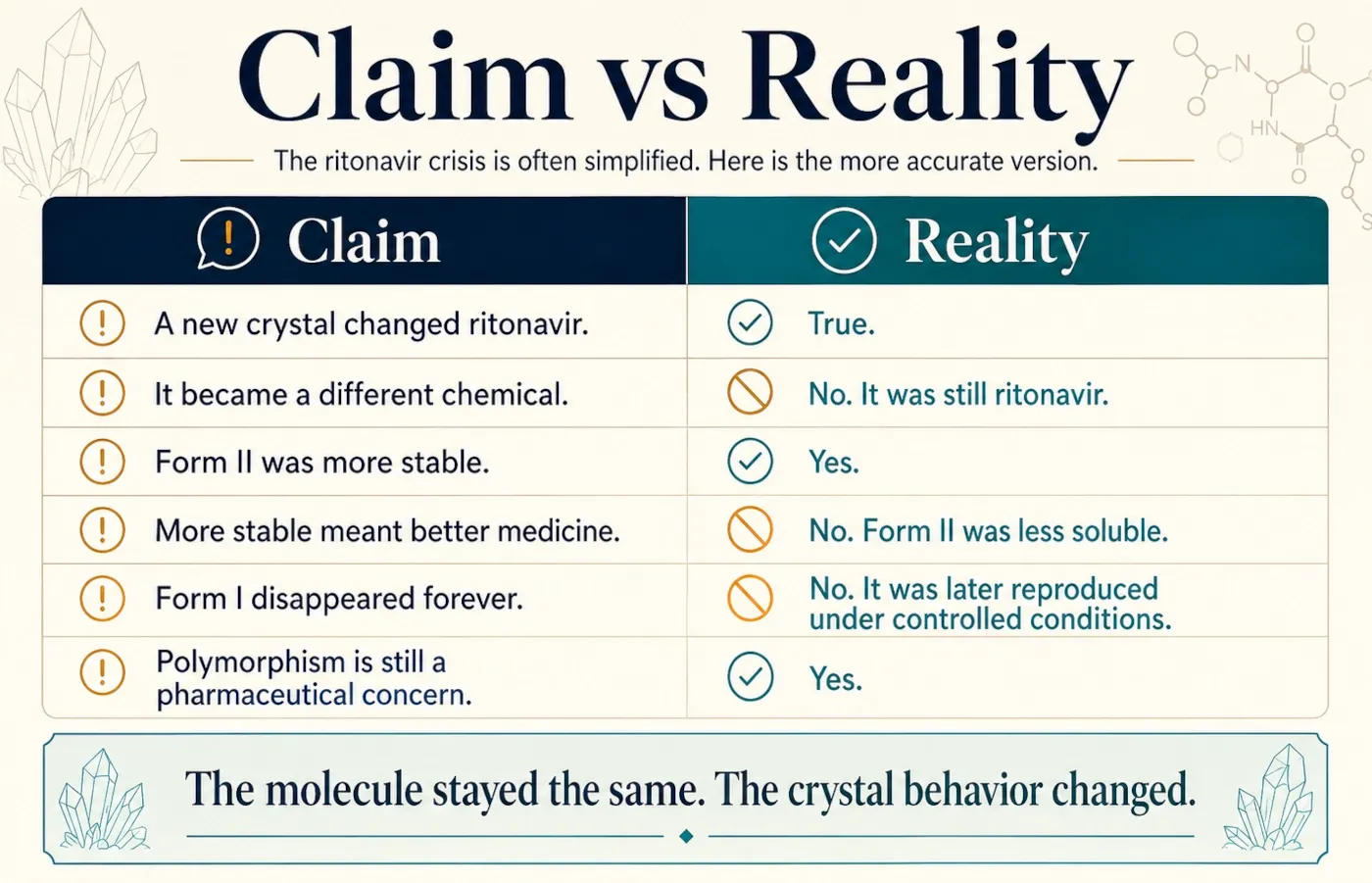
Claim vs reality
| Claim | Reality |
|---|---|
| A new crystal form disrupted ritonavir production. | True. Form II appeared and caused dissolution problems in the marketed formulation. |
| Ritonavir became a different chemical. | No. Forms I and II are different crystal forms of ritonavir. |
| Form II was more thermodynamically stable. | Yes. Its crystal packing was more stable under the relevant conditions. |
| More stable automatically means a better medicine. | No. In this case greater crystal stability was associated with lower solubility. |
| A polymorph can change dissolution. | Yes. This is a well-established pharmaceutical solid-state concern. |
| Form I literally ceased to exist. | No. Later studies reproduced Form I under specially designed conditions. |
| One crystal can destroy every medicine. | No. That is an overstatement of a much narrower solid-state risk. |
| Crystal seeds can influence what crystallizes next. | Yes. Seeding and heterogeneous nucleation are central tools and risks in crystallization. |
| Scientists know exactly what first triggered ritonavir Form II. | No. The initiating event was not conclusively established. |
| Modern pharmaceutical science can perfectly predict every polymorph. | No. Screening and prediction are much stronger today, but the solid-form landscape cannot always be exhaustively proven. |
| Polymorphism still matters in drug development. | Yes. Regulators and manufacturers explicitly consider its effects on product performance and manufacturing. |
Common mistakes
Mistake 1: treating “same molecule” as “same material behavior”
Chemical identity is only part of the story for a solid.
Crystal packing can alter measurable physical properties without changing the molecular formula.
Mistake 2: saying Form II was an impurity
Form II was not a foreign chemical contaminant. It was ritonavir in another crystal form.
Physical contamination by Form II seed crystals could influence crystallization, but the crystals themselves were still ritonavir.
Mistake 3: saying the more stable form must be pharmaceutically superior
Thermodynamic stability can be desirable for storage and process robustness, but it can also reduce solubility.
The best development form is selected using multiple criteria, not stability alone.
Mistake 4: saying Form I transformed because “nothing changed”
Nothing obvious in the recipe needed to change for a new nucleation event to become possible.
Crystallization is sensitive to history, surfaces, impurities, supersaturation, mechanical effects, and rare nucleation events.
Mistake 5: presenting the personnel-seeding story as proven fact
Transport of microscopic seeds is plausible.
The exact chain of events that first created and then distributed Form II in 1998 was not conclusively demonstrated.
Mistake 6: interpreting “disappearing” literally
A disappearing polymorph has become difficult to reproduce under familiar conditions. It has not been deleted from the universe.
Mistake 7: assuming all crystal forms of a drug have different clinical effects
Some polymorphic differences may have little practical effect on a particular dosage form. Risk depends on the properties of the forms and the formulation.
Mistake 8: assuming a successful polymorph screen proves there are no undiscovered forms
Screening reduces uncertainty. It cannot generally prove that every physically accessible crystal form has been found.
Security, privacy and safety notes
This article explains pharmaceutical crystallization and manufacturing history. It does not provide personal medical advice and should not be used to make treatment decisions.
If you currently take ritonavir:
- do not stop, change, replace, split, reformulate, or otherwise alter a prescribed medicine because of this historical case;
- use only approved products supplied through legitimate medical and pharmaceutical channels;
- speak with your prescribing clinician or pharmacist about questions concerning your formulation, dose, storage, interactions, or availability.
The 1998 crystal crisis concerned historical formulations and manufacturing control. It does not mean currently approved ritonavir products are secretly undergoing the same failure.
For laboratory readers, this article is also not a crystallization protocol. Solid-form screening, pharmaceutical formulation, and analytical characterization require validated methods, appropriate facilities, and trained professionals.
Faster alternative
If you only want the core idea, remember this five-line model:
One molecule can form more than one crystal structure.
        ↓
Those structures can have different physical properties.
        ↓
A more stable form may remain hidden because nucleation is difficult.
        ↓
Once it appears, seed crystals can make that form easier to nucleate again.
        ↓
A previously reliable manufacturing process may stop producing the old form.
For ritonavir, the critical difference was that Form II was more stable but much less soluble than Form I, making the original capsule formulation unreliable.
That is the disappearing-polymorph problem in its simplest form.
FAQ
What is a disappearing polymorph?
A disappearing polymorph is a crystal form that was previously prepared and characterized but later becomes difficult or apparently impossible to reproduce using the same procedure because another crystal form begins to form instead.
The old form has not necessarily become physically impossible. The practical crystallization outcome has changed.
Why do polymorphs disappear?
Often because a new, more thermodynamically stable form finally nucleates after being kinetically inaccessible. Once crystals of that form exist, seeding and heterogeneous nucleation can make it easier for the new form to appear again, while the old metastable form becomes difficult to obtain.
Not every case has the same mechanism.
What is a crystal polymorph?
A crystal polymorph is one of multiple crystalline structures that can be formed by the same chemical substance. The molecules are chemically the same but arranged differently in the solid lattice.
What is pharmaceutical polymorphism?
Pharmaceutical polymorphism is the ability of a drug substance to exist in different crystal structures. It matters because polymorphs can differ in solubility, dissolution rate, stability, mechanical behavior, and manufacturing properties.
What was the disappearing polymorph of ritonavir?
Form I is the form commonly described as the disappearing polymorph.
It was the original crystalline form used during development. After the more stable Form II emerged, producing Form I reliably using the former process became extraordinarily difficult.
What happened to ritonavir in 1998?
Some batches of the marketed Norvir capsule formulation failed dissolution specifications. Investigators identified a new ritonavir crystal form, Form II, which was substantially less soluble than Form I.
The original capsule formulation was removed from the market, oral solution served as an alternative, and a new capsule formulation compatible with the new solid-form reality was developed.
Why did ritonavir Form II cause a problem?
Because it was much less soluble than Form I.
The new crystal form precipitated in the formulation and slowed dissolution enough that batches failed product specifications.
Why was ritonavir Form II less soluble?
Form II has a different molecular conformation and crystal packing, including a stronger stabilizing intermolecular hydrogen-bond network. That makes the solid lattice more thermodynamically stable and makes escape of molecules into solution less favorable under relevant conditions.
What caused ritonavir to crystallize into Form II?
The exact first trigger was not conclusively proven.
Scientific work from Abbott proposed that a highly supersaturated environment together with probable heterogeneous nucleation—possibly involving a degradation product—allowed Form II to nucleate. Once Form II existed, seeding could make subsequent Form II nucleation easier.
Can crystal seeds spread between laboratories?
Physical particles can be transported between environments, and seed crystals can influence crystallization.
However, claims that personnel definitively carried ritonavir Form II from one specific facility to another should be treated as a hypothesis rather than established fact. The original initiating and transmission events were not conclusively reconstructed.
Did ritonavir Form I disappear forever?
No.
Later high-throughput crystallization, solvent-based studies, and mechanochemical research showed that Form I can be produced under carefully selected conditions. “Disappearing” refers to loss of reliable reproduction by the previous route, not literal physical extinction.
How was the ritonavir polymorph crisis solved?
In the short term, oral solution maintained treatment availability when the original capsule formulation could not be supplied reliably.
Longer term, Abbott developed and obtained approval for a reformulated capsule designed to maintain acceptable performance despite the existence of Form II. The solution was to control the product in a Form II world, not to assume Form II could be removed from existence.
How does polymorphism affect drug absorption?
It can affect absorption indirectly when different polymorphs have sufficiently different solubility or dissolution rates and the drug’s absorption is sensitive to dissolution.
The FDA emphasizes that the impact is drug- and formulation-specific. Different polymorphs do not automatically produce different bioavailability.
Can other drugs have disappearing polymorphs?
Yes.
The scientific literature describes other examples, including ranitidine hydrochloride and progesterone. The phenomenon is not unique to ritonavir, although ritonavir remains the most famous pharmaceutical case because of its manufacturing and supply impact.
Can polymorphs be predicted?
Partly.
Modern crystal structure prediction can identify plausible crystal packings and rank their energies, while experimental screening tests which solid forms can actually be made under realistic conditions.
A 2025 retrospective ritonavir study concluded that modern CSP would have identified the then-undiscovered Form II as a serious risk. But no method can guarantee that every possible polymorph of every molecule has been found and experimentally understood.
Are disappearing polymorphs still a problem today?
They remain a real solid-state risk, but pharmaceutical science is much better equipped to manage that risk than it was in 1998.
Modern development uses broader solid-form screening, sensitive analytical methods, high-throughput experiments, process understanding, computational prediction, regulatory controls, and stability monitoring. These measures reduce uncertainty without eliminating it completely.
Final verdict: could one crystal destroy all medicine?
No.
But the ritonavir crisis revealed something more useful than the viral version of the story.
A medicine can remain chemically identical while a change in crystal structure alters its solubility and makes an existing formulation or manufacturing process unreliable. A thermodynamically favored form can remain hidden for years because nucleation is difficult. Once that form finally appears, seed crystals and new nucleation pathways can make it much easier to reproduce, while the previously familiar form becomes elusive.
That is why disappearing polymorphs matter.
The lesson is not that every medicine could vanish tomorrow. It is that solid-state structure is part of pharmaceutical behavior, and discovering a molecule is not the same as discovering every way that molecule can organize itself as a solid.
Ritonavir turned that abstract principle into a real manufacturing crisis. The decades of research that followed also produced the more reassuring part of the story: disappearing polymorphs can be studied, recovered, predicted more effectively, and managed with far better tools than scientists had in 1998.
Last tested
Tested on:
- Not applicable — this is a scientific explainer rather than a software or procedural guide.
- Scientific claims were checked against the peer-reviewed and regulatory references listed in the frontmatter.
Last tested: 2026-08-21
Related guides
Carefully selected guides to help you understand the topic and complete the next useful step.